About 819 minutes
Military Reminiscences of the Civil War, Volume 1: April 1861-November 1863 — Key Ideas to Explore
Modern Nations
188,348 recorded words. 5 minutes difference from this book's estimate.
View Gutenberg source #6961
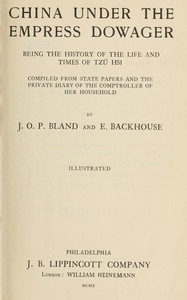
The catalog record for China under the Empress Dowager — Edition Insights provides practical reading context through 187,009 words, 13 hr 34 min estimated reading time, and 41 detected text sections.
The text analysis averages about 30.6 words per sentence, while the detected sections provide another way to judge how the source is divided.
Project Gutenberg metadata also associates the work with “Cixi, Empress dowager of China, 1835-1908,” connecting these edition facts with the source record’s subject description.
Explore this collection
These alternatives are selected using recorded categories and estimated reading time.
About 819 minutes
Modern Nations
188,348 recorded words. 5 minutes difference from this book's estimate.
View Gutenberg source #6961About 786 minutes
Modern Nations
180,752 recorded words. 28 minutes difference from this book's estimate.
View Gutenberg source #10807About 761 minutes
Modern Nations
174,886 recorded words. 53 minutes difference from this book's estimate.
View Gutenberg source #57247Search stored excerpts and compare books → Choose by your preferences →
Choices use stored catalog measurements. Estimates vary with reading speed. A shared category is a catalog label, not a claim that two books have the same argument or literary quality.
Search reads excerpt text stored with this catalog and links to its associated Gutenberg record. The connection is stored in the site database; this tool does not recheck that every excerpt is word-for-word identical to that external record. Excerpt search does not cover every chapter and does not verify historical publication dates.
Catalog snapshot checked: 2026-09-25. Coverage: 99 public books, 99 available source excerpts.
Read the complete public-domain text at its original source.
Read on Project GutenbergThe authors, J. O. P. Bland and Sir Edmund Backhouse, present this history as compiled from state papers and the private diary of the Comptroller of the Empress Dowager's household. The work opens with a photograph of Tzŭ Hsi (Cixi) from 1903, captioned 'The Holy Mother,' establishing the dual reverence and scrutiny that characterizes the narrative. The table of contents reveals a chronological structure from her youth to her death, with chapters devoted to the Taiping Rebellion, the Boxer Movement, and the Reform Movement of 1898.
The excerpts show a text that blends official documents with personal observations, such as the diary entry of His Excellency Ching Shan, which records court debates over the Boxers. The writing is dense with specific names, titles, and bureaucratic details, reflecting the authors' access to primary sources. The narrative voice is detached yet occasionally editorial, as when it notes the 'stormy meeting at the Grand Council' or quotes the Empress Dowager's classical allusion to interdependence between north and south.
The diary of Ching Shan, included in full, offers a granular view of the court's internal divisions during the Boxer uprising. Entries from the 5th moon of 1900 record Prince Tuan's desire to depose the Guangxu Emperor and install his own son, opposed by Viceroy Liu K'un-yi, who warned that his province would rebel. The Empress Dowager is shown quoting the Tso Chuan to argue for northern-southern interdependence, while simultaneously authorizing bounties on foreign heads: Tls. 50 for a male barbarian, Tls. 40 for a woman, Tls. 30 for a child.
Jung Lu, a key figure, is described as 'loud in denouncing the Boxers' yet unable to prevent the violence. The diary captures the tension between personal loyalties and state policy, as when Ching Shan notes his own sons quartering Boxers in their courtyard while he grudges the cost of rice. These passages reveal a court paralyzed by competing agendas, where classical learning coexists with brutal pragmatism.
The diary of Ching Shan, Comptroller of the Household, provides a first-person perspective rare in official histories. His entries mix bureaucratic routine with personal anxiety: he travels by cart because his chair-bearers have fled or joined the Boxers; he frets over his sons' expenses; he compares his own miserliness to a historical figure who stored cash in labeled heaps. These details humanize a figure otherwise lost in the grand narrative of dynastic decline.
The diary also records direct speech, as when Prince Li is described as 'much depressed' and Jung Lu 'looks very tired, and walks with a limp.' Such observations ground the political drama in physical and emotional reality. The authors' decision to include this diary in full suggests they valued its unvarnished testimony over official accounts, though the excerpts are too brief to confirm whether this trust is warranted.
The Empress Dowager's use of the Tso Chuan—'the upper and lower jaws mutually assist each other; if the lips shrivel, then must the teeth catch cold'—is a striking example of how classical texts were deployed in court debate. She applies this proverb to argue that the northern and southern parts of the empire are interdependent, implicitly rebuking Viceroy Liu K'un-yi for refusing to send troops north. The allusion carries weight because it invokes a canonical authority that all officials would recognize.
This rhetorical strategy appears elsewhere in the excerpts: Ching Shan compares himself to a miserly Liang Dynasty official, and the authors note that the Empress Dowager 'quoted the words of the Classic Historical Commentary.' Such references are not mere decoration; they are tools of persuasion in a political culture where classical learning was a marker of legitimacy. The text thus reveals how power was exercised through language as much as through force.
Readers should approach this work as a product of its time—a 1910 biography that relies heavily on a single insider diary and the authors' own interpretations. The excerpts show a text rich in detail but also shaped by the authors' access and biases. For a fuller understanding, compare this account with other sources on the Boxer Rebellion and the Empress Dowager's reign, noting where the diary's perspective may diverge from official records or later scholarship.
That rainy afternoon, China under the Empress Dowager felt less like history than like eavesdropping—Cixi’s court, the careful diaries, the weight of supply and survival. When the storm wouldn’t quit, my fingers wandered to a shelf, landing on The Supplies for the Confederate Army, how they were obtained in Europe and how paid for. — Inside the Classic. There it was again: the quiet, desperate logistics behind grand narratives. Rain, paper, and the strange kinship of other people’s wars.
Build a private reading journal entry for this title.