1

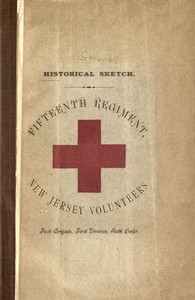
Historical sketch of the Fifteenth Regiment, New Jersey Volunteers First Brigade, First Division, Sixth Corps — A Reader’s Guide
(0 User reviews)
2097
Project Gutenberg
2011
Not confirmed
United States -- History -- Civil War, 1861-1865 -- Regimental histories; United States. Army. New Jersey Infantry Regiment, 15th (1862-1865); New Jersey -- History -- Civil War, 1861-1865 -- Regimental histories
Readers of public-domain and historical texts
Project Gutenberg digital edition
en
Edition facts
Words
10,276
Reading time
45 min
Text sections
2
Historical sketch of the Fifteenth Regiment, New Jersey Volunteers First Brigade, First Division, Sixth Corps — A Reader’s Guide can be approached with a clearer sense of reading commitment from its source measurements: 10,276 words, 45 min estimated reading time, and 2 detected text sections.
The text analysis averages about 17.0 words per sentence, while the detected sections provide another way to judge how the source is divided.
Project Gutenberg metadata also associates the work with “United States -- History -- Civil War, 1861-1865 -- Regimental histories,” connecting these edition facts with the source record’s subject description.
Source:
Project Gutenberg record #35697
Edward Livingston Campbell's 1880 regimental history traces the Fifteenth New Jersey Volunteers from its hill-country recruitment through the Wilderness Campaign, using official rolls and a soldier's letter to document the unit's character and heavy losses.
Read the complete public-domain text at its original source.
Read on Project GutenbergCampbell opens by asserting that every regiment has a distinct character, shaped by the men who compose it. The Fifteenth New Jersey, he explains, was recruited from the state's rural hill country—Sussex, Warren, Hunterdon, Morris, and Somerset—drawing freeholders and their sons, men of education and moral standing. This demographic detail is not incidental; it becomes the lens through which Campbell interprets the regiment's battlefield conduct. He notes that many soldiers had liberal educations and were training for professional life, and he credits their rural, land-owning background with fostering a tenacious patriotism. The sketch thus begins as a sociological portrait before it becomes a military chronicle.
From Mustering to Fortifications
The regiment was mustered into service on August 25, 1862, and moved to the front just two days later, at the height of the Second Bull Run campaign. Campbell records that their first duty was not combat but construction: building fortifications at Tenallytown, Maryland, laboring day and night for about a month. This early assignment sets a pattern of hard, unglamorous work that recurs throughout the narrative. The author’s attention to the regiment’s origins and initial tasks establishes a baseline of discipline and physical endurance that he will later contrast with the horrors of sustained battle.
The Cost of the Wilderness
Campbell includes a lengthy casualty list from the Wilderness Campaign (May 4–15, 1864), reproduced from a letter to the Sussex Register. The letter, signed by Marshall B. Stull, provides a raw, immediate account: officers killed in a charge, men shot through the lungs, a captured battle-flag taken from breastworks. Stull apologizes for his “confused statement,” a telling admission of the chaos of sustained combat. The list that follows names dozens of killed, wounded, and missing by company, from privates to captains. Campbell lets this document speak for itself, embedding a primary source that conveys the scale of loss more powerfully than any summary could.
A Roll Answered in Blood
In a later passage, Campbell reflects on the regiment’s total casualties: 361 dead, the highest loss of any New Jersey regiment, from an original strength of 947. He writes that such a record “must be traced in blood,” and calls for the names to be “written in gold.” The language is deliberately solemn, but it is grounded in a precise statistic—the regiment’s disproportionate sacrifice relative to its size. Campbell also acknowledges the unknown number of men crippled by wounds or wasted by disease, broadening the definition of loss beyond the killed. This section functions as a moral reckoning, tying the earlier demographic portrait to its grim outcome.
Structure and Voice in a Regimental History
Campbell’s narrative moves between official summary and embedded firsthand testimony. The opening sociological analysis gives way to a chronological campaign account, then to the raw letter, and finally to a reflective coda. This structural shift mirrors the arc from organization to experience to memory. The author’s own voice is present throughout—he notes that he “saw much of Union soldiers” and hopes to speak without “invidious comparison”—but he cedes authority to the casualty roll and the correspondent’s letter. Readers should attend to these shifts in register, as they reveal Campbell’s dual purpose: to document and to commemorate.
Campbell’s sketch is best read as a hybrid: part statistical record, part memorial. The casualty lists and the embedded letter from the Wilderness offer the most direct access to the regiment’s experience, while the opening pages provide a framework for understanding who these soldiers were. Because the excerpts are incomplete, the full arc of the regiment’s service from Fredericksburg to Appomattox is only hinted at. Readers may wish to compare the tone of the opening with the closing passages to see how Campbell’s perspective evolves across the narrative.
The rain slid down the window, and Campbell’s rolls of the Fifteenth felt like names whispered in a dark room. Their hard miles, their thinning lines—it left a quiet ache. Reaching for something else, I found History of Morgan's Cavalry — Story, Setting & Ideas, and it offered a strange counterpoint: movement and fire, not endurance, but its own ragged humanity. Two different wars, same haunting weight.
There are no reviews for this eBook.
There are no comments for this eBook.
Reader reflection
How will you remember this book?
Save your reaction, strongest insight, and memorable passage.
Your progress
0
/
10
2
How much did you enjoy the reading experience?
3
Would you recommend this book to another reader?
4
How easy was the book to follow?
5
How original did the book feel?
6
Was the book moving at the right speed?
7
Would you like to discuss this book with someone?
8
How understandable was the text?
9
What did this book teach you most?
10