1

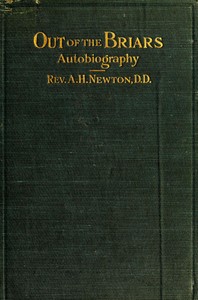
Out of the Briars An Autobiography and Sketch of the Twenty-ninth Regiment Connecticut Volunteers — A Closer Reading
(0 User reviews)
79
Project Gutenberg
2022
Not confirmed
United States -- History -- Civil War, 1861-1865; African American soldiers; United States -- History -- Civil War, 1861-1865 -- Participation, African American; United States. Army. Connecticut Infantry Regiment, 29th (1864-1865); Connecticut -- History -- Civil War, 1861-1865; Free African Americans; African American clergy; African Methodist Episcopal Church; Newton, A. H. (Alexander Herritage), 1837-
Readers of public-domain and historical texts
Project Gutenberg digital edition
en
Edition facts
Words
60,361
Reading time
263 min
Text sections
20
The source record for Out of the Briars An Autobiography and Sketch of the Twenty-ninth Regiment Connecticut Volunteers — A Closer Reading measures this digital text at 60,361 words, 4 hr 23 min estimated reading time, and 20 detected text sections.
The text analysis averages about 17.6 words per sentence, while the detected sections provide another way to judge how the source is divided.
Project Gutenberg metadata also associates the work with “United States -- History -- Civil War, 1861-1865,” connecting these edition facts with the source record’s subject description.
Source:
Project Gutenberg record #68319
A. H. Newton's autobiography combines a Civil War soldier's account of the 29th Connecticut Volunteers with his later career as an A.M.E. minister, drawing on a daily diary to document personal loss, church building, and reflections on race.
Read the complete public-domain text at its original source.
Read on Project GutenbergNewton opens his autobiography by explaining that he never intended to publish, but kept a daily diary that grew into three volumes. Comrades and fellow ministers frequently consulted it for Civil War details and church history, leading him to publish as a service to his race and an inspiration to young people. The title Out of the Briars reflects his sense of being freeborn yet born under slavery's curse, surrounded by thorns.
The book is structured in two main parts: a war record and sketch of the 29th Connecticut Volunteers, and a ministerial life covering his A.M.E. Church work. Newton includes sermons, articles, and resolutions, making the volume a hybrid of personal narrative, regimental history, and denominational documentation.
A Diary-Driven Narrative
Newton's method is unusual: he claims to have kept a daily record for years, letting no day pass without an entry. This diary became the backbone of the autobiography, consulted by others for factual reference. The preface stresses that the published work is not egotistical but practical—a reference tool. This documentary impulse shapes the book's tone, which often reads as a compilation of records rather than a flowing memoir. Newton includes statistics from church conferences and census data, reinforcing the idea that his life is a case study for broader racial progress.
Loss and the Burden of Faith
A poignant section describes the death of a daughter at age twenty-seven, a teacher and musician. Newton recounts receiving a telegram while traveling to a Jersey City appointment, then returning home. He reflects on the difficulty of truly casting his burden on the Lord, admitting he would take burdens to God but bring them away again. This honest self-critique—"Ah! There is the point, I would bring them away with me!"—gives the spiritual reflection a personal, unvarnished quality. He advises readers to learn early to leave burdens with God, noting he is now too old to carry them.
Church Work and Material Struggles
Newton's account of his pastorate in Jersey City details specific collaborators: Bros. Taper, Dougherty, Stokes, Holmes, and sisters Stokes, Taper, Dougherty, Holmes, Burk, Dowers. He mentions a Mr. Beach who served as treasurer and contributed personal funds. The congregation paid $500 on church debt and left lumber and brick for a new building, adding over one hundred members. Newton also records the 1905 New Jersey Conference, where Bishop B. W. Arnett presided, and notes a concern that the church had become too focused on machinery and money, losing spiritual power. He calls for a return to "the Old Time Religion."
Readers should approach Out of the Briars as a document assembled from diary entries, not a polished literary autobiography. Newton's voice is direct and practical, often listing names, debts, and statistics. The war sketch and ministerial sections are distinct but linked by his dual identity as soldier and pastor. The book offers primary-source material on African American church life and Civil War memory, but its value lies in the specific, unadorned details Newton chose to preserve.
Reading Newton’s quiet accounting of daily loss, I remembered sitting on my grandfather’s porch, tracing his finger over a worn diary. He never spoke of the war, only of the harvest. The French Revolution — Story, Setting & Ideas once gave me that same ache—history not as grand noise, but as a man’s small, stubborn record of keeping on. Both books whisper: we endure by writing it down.
There are no reviews for this eBook.
There are no comments for this eBook.
Reader reflection
How did this book work for you?
Your answers remain private and are stored only in this browser.
Your progress
0
/
10
2
What was your overall reaction to the book?
3
Is this a title you would suggest to others?
4
Did the language feel accessible?
5
How did the pace of the book feel?
6
Could you follow the author’s main argument?
7
Did it raise ideas you would like to talk about?
8
Did any part of the book stay with you emotionally?
9
What changed or sharpened your thinking?
10