1

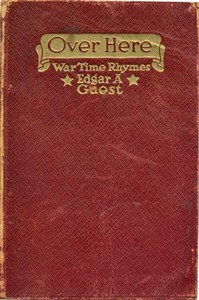
Over Here — A Reader’s Guide
(0 User reviews)
999
Project Gutenberg
2005
Not confirmed
World War, 1914-1918 -- Poetry
Readers of public-domain and historical texts
Project Gutenberg digital edition
en
Edition facts
Words
28,756
Reading time
126 min
Text sections
16
This digital edition of Over Here — A Reader’s Guide is described by source-level measurements including 28,756 words, 2 hr 6 min estimated reading time, and 16 detected text sections.
The text analysis averages about 27.3 words per sentence, while the detected sections provide another way to judge how the source is divided.
Project Gutenberg metadata also associates the work with “World War, 1914-1918 -- Poetry,” connecting these edition facts with the source record’s subject description.
Source:
Project Gutenberg record #16632
Edgar A. Guest's 1918 poetry collection focuses on the American home front during World War I, emphasizing sacrifice, duty, and the emotional distance between those who fight and those who wait. The poems reveal a tension between public optimism and private grief, with recurring motifs of hope, gold as a lesser gift, and the desire to be worthy of soldiers' sacrifices.
Read the complete public-domain text at its original source.
Read on Project GutenbergEdgar A. Guest's Over Here (1918) presents a series of poems written from the American home front during World War I. The title itself signals the collection's perspective: these are verses for those who remain behind, not for soldiers in the trenches. Guest, already known for his sentimental, accessible style in collections like A Heap o' Livin', here turns his attention to the war effort, addressing mothers, fathers, and civilians who must support the troops from afar. The poems are unified by a consistent meter and rhyme scheme, often employing quatrains with alternating rhymes, and a direct, conversational tone that avoids complex imagery. While the catalog subject lists only 'World War, 1914-1918 -- Poetry,' the excerpts reveal a narrower focus: not the war itself, but the emotional and moral landscape of those who are 'over here.'
The Home Front as a Moral Arena
Guest repeatedly frames the civilian experience as a test of character. In 'The Gold Givers,' he contrasts those who gave sons or their own lives with those who could only give money: 'How pitiful my gift shall seem, when all I gave is gold.' The poem's speaker anticipates a future reckoning, standing in silence while mothers say 'For truth I gave my son.' This moral hierarchy—placing the sacrifice of life above all other contributions—runs throughout the collection. Similarly, 'Why We Fight' warns against 'the cry of the quitter' and urges readers to 'stand firm for the cause that we plead,' even when facing 'fearful disasters' and 'the pangs of defeat.' The poems do not describe battles or strategy; instead, they prescribe attitudes: steadfastness, hope, and a refusal to compromise. Guest's home front is a place where resolve is constantly tested, and where the greatest failure is not cowardice in combat but weakness of spirit at home.
Recurring Imagery of Waiting and Watching
The excerpts are rich with images of people who wait, watch, and pray. In 'Hope,' a mother 'rocks her boy' and 'dreams of the joy / He'll bring in the future days,' while a father works at his anvil, looking ahead to 'sweet peace when his work is done.' The poem 'Over Here' (the title piece) describes those who 'stand, who cannot share the fray' and who 'for them at night we kneel and pray.' This posture of waiting is active, not passive: it involves prayer, work, and the maintenance of hope. The physical distance between the home front and the battlefield is emphasized by the repeated use of 'here' and 'there.' In 'The Gold Givers,' the speaker imagines a future gathering where 'some shall say, 'I fell in France,' and some, 'I mourned my dead.'' The collection thus creates a geography of separation, where the home front is defined by its relation to an absent front line.
Tension Between Public Cheer and Private Grief
Despite its overall tone of encouragement, Over Here contains moments that acknowledge the cost of war. 'The Undaunted' describes a wounded soldier who, after lying in 'a shell hole's slime and mud / That was partly dirty water, but was mostly human blood,' pleads to return to the trenches. The poem's admiration for his courage is undercut by the visceral detail of his suffering. Similarly, 'Why We Fight' admits that 'We shall weep for the best of our manliest youth' and 'suffer the pangs of defeat.' These lines sit uneasily alongside the more buoyant calls to action. Guest does not resolve this tension; instead, he insists that hope and grief can coexist. The poem 'Hope' explicitly frames hope as a sustaining force: 'Brightly the star of hope / From the distance is shining still.' The collection thus offers a complex emotional landscape, where public rhetoric of duty and optimism is shadowed by private awareness of loss.
Readers approaching Over Here should attend to the specific historical context of 1918, when the war's outcome was uncertain and casualty lists were mounting. Guest's poems are not journalism or memoir but a deliberate literary construction of home-front morale. The repeated use of direct address—'Let us,' 'We stand,' 'Mine is the song'—creates a sense of collective voice that may feel dated or propagandistic to modern readers. Yet the poems also reveal genuine anxiety and sorrow, making them a valuable document of how one popular poet attempted to reconcile duty with grief. The collection rewards attention to its quieter, more ambivalent moments, where the official optimism falters.
Sometimes I think about those waiting at home in Guest’s poems, holding hope like a small, worn stone. There’s a quiet ache there that stayed with me. Reading about Guynemer’s solitary flights felt oddly similar, that same distance between the one who acts and the one who watches. Georges Guynemer: Knight of the Air — Text and Context carries that weight gently, and I found myself lingering on it long after.
There are no reviews for this eBook.
There are no comments for this eBook.
Reader reflection
Your personal reading reflection
Build a private reading journal entry for this title.
Your progress
0
/
10
2
Was reading this book enjoyable?
3
Would you pass this book on to a friend?
4
What was the reading difficulty like?
5
Would you like to discuss this book with someone?
6
Did the book offer a fresh perspective?
7
How much did the book move you?
8
What did you appreciate most?
9
Which lesson or insight stayed with you?
10