1

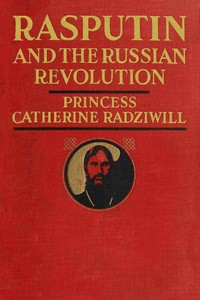
Rasputin and the Russian Revolution — Reading Notes
(0 User reviews)
770
Project Gutenberg
2021
Not confirmed
Soviet Union -- History -- Revolution, 1917-1921; Rasputin, Grigorii Efimovich, 1869-1916
Readers of public-domain and historical texts
Project Gutenberg digital edition
en
Edition facts
Words
87,092
Reading time
379 min
Text sections
22
This digital edition of Rasputin and the Russian Revolution — Reading Notes is described by source-level measurements including 87,092 words, 6 hr 19 min estimated reading time, and 22 detected text sections.
The text analysis averages about 31.6 words per sentence, while the detected sections provide another way to judge how the source is divided.
Project Gutenberg metadata also associates the work with “Soviet Union -- History -- Revolution, 1917-1921,” connecting these edition facts with the source record’s subject description.
Source:
Project Gutenberg record #66358
Princess Catherine Radziwill's 1918 account examines Rasputin's influence on the Russian court, drawing on her insider perspective. The text traces the conspiracy against him, the failure of a staged scandal to discredit him, and the political entanglements of figures like Manassevitsch-Maniuloff and Sturmer.
Read the complete public-domain text at its original source.
Read on Project GutenbergPrincess Catherine Radziwill opens her account of Rasputin and the Russian Revolution with a personal dedication to Jean Finot, acknowledging his role in encouraging her literary career. This framing signals that the book is not a detached history but a memoir-infused analysis from someone who moved within Russian court circles. The publisher's foreword further establishes the work's risky origins: Radziwill had previously published under the pseudonym Count Paul Vassili, presenting her earlier book as posthumous to avoid persecution. The text thus carries the tension of a witness writing under threat, a perspective that shapes its treatment of Rasputin's rise and the conspiracy that eventually ended him.
A Conspiracy That Failed
Radziwill describes an early attempt to discredit Rasputin through a staged scandal at a music hall. The plan was to entangle him in a drunken episode involving Khlisty dancing, then call the police to draw up a report. The conspirators hoped this would force Rasputin to leave Petrograd. Instead, the person who brought the report to a high authority was treated as a libeler and compelled to retire from public life. The episode reveals two things: the extent to which Rasputin's enemies were willing to go, and the utter failure of conventional scandal to damage him. Radziwill notes that after this, it was generally recognised that nothing would be strong enough to bring about his downfall.
The Manassevitsch-Maniuloff Affair
A key figure in Radziwill's narrative is Manassevitsch-Maniuloff, described as the prime mover in the dark intrigue around Rasputin. He was arrested for blackmail but released on bail after no incriminating documents were found among his confiscated papers. Once free, he set Rasputin to working in his favour, and the prophet's renewed activity exasperated the public to the point that the first thought of organising a conspiracy to remove him was started. Radziwill traces a chain of influence: Manassevitsch-Maniuloff threatened to make revelations damaging to highly placed personages, inspiring terror even among those eager to see him condemned. The episode illustrates how Rasputin's network operated through fear and blackmail, and how attempts to prosecute his allies could backfire.
Sturmer's Resignation and Lingering Power
Radziwill records that the Opposition party in the Duma forced Prime Minister Sturmer to resign, but he secured appointment as High Chancellor of the Imperial Court, one of the most important positions in Russia. She emphasises that he did not fall into disgrace but remained the power behind the throne, though not officially recognised. The distinction she draws—between being dismissed and simply going away—is central to her understanding of how the Russian court operated. Sturmer's continued influence, even after losing his ministerial post, shows the difficulty of dislodging those protected by the imperial system. Radziwill's phrasing underscores the gap between official appearances and actual power, a theme that runs through her account of Rasputin's own position.
Radziwill's narrative is valuable for its proximity to events and its willingness to name names, but readers should note that she writes as a participant with her own loyalties and grievances. The excerpts show a world where public scandal could be neutralised, blackmailers could intimidate the powerful, and resignation did not mean loss of influence. These patterns, rather than a simple story of Rasputin's villainy, are what give the book its particular texture.
Reading Radziwill’s account of Rasputin’s shadowy hold on the court, I remembered the quiet, unsettling feeling of wartime secrecy in A History of Lumsden's Battery, C.S.A. — Story, Setting & Ideas. Both books whisper about men caught in currents larger than themselves, and I sat with that weight for a long while, just letting the pages settle.
There are no reviews for this eBook.
There are no comments for this eBook.
Reader reflection
How will you remember this book?
Save your reaction, strongest insight, and memorable passage.
Your progress
0
/
10
2
How did the book work for you overall?
3
Would you recommend this book to another reader?
4
How easy was the book to follow?
5
Could you follow the author’s main argument?
6
Do you expect to return to this book?
7
Would you like to discuss this book with someone?
8
How did the pace of the book feel?
9
What is the main idea you are taking away?
10