1

The History of the Catnach Press at Berwick-Upon-Tweed, Alnwick and Newcastle-Upon-Tyne, in Northumberland, and Seven Dials, London — Themes and Context
(0 User reviews)
192
Project Gutenberg
2013
Not confirmed
England -- Imprints; Ballads, English -- England -- Bibliography; Catnach, James, 1792-1841; Ballads -- Publishing -- England -- History -- 19th century; Chapbooks -- Publishing -- England -- History -- 19th century; Children's literature -- Publishing -- England -- History -- 19th century; Printing -- England -- History -- 19th century
Readers of public-domain and historical texts
Project Gutenberg digital edition
en
Edition facts
Words
59,349
Reading time
259 min
Text sections
12
Before opening The History of the Catnach Press at Berwick-Upon-Tweed, Alnwick and Newcastle-Upon-Tyne, in Northumberland, and Seven Dials, London — Themes and Context, the edition data offers a quick orientation: 59,349 words, 4 hr 19 min estimated reading time, and 12 detected text sections.
The text analysis averages about 22.1 words per sentence, while the detected sections provide another way to judge how the source is divided.
Project Gutenberg metadata also associates the work with “England -- Imprints,” connecting these edition facts with the source record’s subject description.
Source:
Project Gutenberg record #43691
Charles Hindley's 1886 history of the Catnach Press traces the movement of a ballad-printing business from Berwick to London's Seven Dials, using reprinted street literature and execution accounts to show how cheap print shaped 19th-century popular culture.
Read the complete public-domain text at its original source.
Read on Project GutenbergCharles Hindley's The History of the Catnach Press (1886) is built around a series of reprinted ballads, broadsides, and chapbooks, each introduced by the author's commentary. The work's structure alternates between Hindley's narrative and the original texts, creating a layered document that mirrors the press's own output. The excerpts show a particular interest in the physical movement of the press—from Berwick to Alnwick, Newcastle, and finally Seven Dials—and in the way street literature responded to sensational events, such as the 1831 execution of the 'Burkers' Bishop and Williams. Hindley frames James Catnach as a 'pioneer in the cause of promoting cheap literature,' but the evidence suggests the book is as much about the ephemeral products as the man.
A Geography of Print
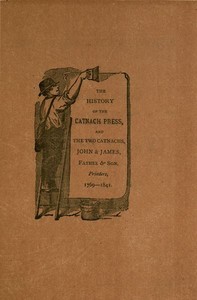
The title page itself maps the press's journey: Berwick-Upon-Tweed, Alnwick, Newcastle-Upon-Tyne, and Seven Dials, London. Hindley's historical introduction reinforces this sense of movement, describing how Catnach's operation shifted southward. The excerpts include a dedication to two Alnwick residents, grounding the narrative in specific northern locations. This geographical layering is not merely decorative; it reflects the actual circulation of ballads and chapbooks across regions. Hindley notes that the first edition of 1869 was limited to 250 copies, a detail that contrasts with the mass-produced street literature the press was known for. The book itself becomes a kind of collectible artifact, mirroring the rarity of some Catnach imprints.
Execution Broadsides and the Crowd
A substantial excerpt reproduces a broadside on the 'Dreadful Burkers of 1831,' detailing the execution of Bishop and Williams. The language is vivid and immediate: 'the most dreadful yells and hootings were heard among the crowd,' and Williams 'looked the most miserable wretch it is possible to conceive.' Hindley includes not just the ballad but also follow-up reports—a post-obit prosecution, a drama at an unlicensed theatre—showing how a single event generated multiple print forms. The crowd's reaction is a recurring motif: cheers when a respited convict's chain is removed, groans at the scaffold. These details suggest that Hindley is as interested in the public's reception as in the press's output.
Pope, Boswell, and the Moral Frame
Hindley opens with a Pope epigraph—'Just as the twig is bent the tree's inclined'—and a Boswell quotation on knowledge. These learned references sit oddly beside the rough ballads that follow, but they signal Hindley's attempt to elevate street literature. He calls Catnach 'the great Mæcenas and Elzevir of the Seven Dials,' classical comparisons that seem inflated. Yet the excerpts show a genuine tension: Hindley admits the productions contained 'little that was likely to enlighten the intellect,' while arguing they 'served well in creating an impetus' toward higher things. This moral framing recurs in his description of Catnach's store as 'like the conjuror's bag—inexhaustible,' a phrase that blends wonder with a hint of trickery.
Repeated Words, Shifting Voices
Certain phrases echo across the excerpts. 'Pioneer' appears in the opening; 'enterprising man' is used of Catnach; the crowd's 'yells and hootings' in the execution scene are mirrored by 'groans and hisses' later. Hindley's own voice shifts between antiquarian detachment and moral commentary. The reprinted ballads, by contrast, are stark and direct: 'Thus died THE DREADFUL BURKERS OF 1831.' This juxtaposition of registers—Hindley's polite prose and the broadsides' raw sensationalism—creates a structural rhythm. The book does not simply describe Catnach's press; it performs the collision between respectable collecting and street culture, a tension that is never fully resolved.
The Limited Edition and the Mass Market
Hindley's own publication history mirrors Catnach's. The first edition of The Catnach Press (1869) was 'Guaranteed Only Two Hundred and Fifty Copies Printed,' with copies numbered and signed. This exclusivity contrasts sharply with the thousands of cheap ballads Catnach produced. The 1886 edition retains this limited-edition framing, even as it reprints ephemeral texts. The excerpts include a blank page for a purchaser's name and date, turning the book into a personalized object. This tension between rarity and abundance runs through the work: Hindley is preserving street literature by turning it into a collectible, a paradox that the reader may find instructive.
Readers approaching The History of the Catnach Press should attend to the interplay between Hindley's commentary and the reprinted texts. The book is not a straightforward narrative but a collage of voices, from the author's antiquarian asides to the blunt language of execution broadsides. Noticing how Hindley frames each document—with moral judgments, classical allusions, or geographical markers—reveals his own assumptions about literacy and class. The work rewards a slow reading that moves between the main text and the footnoted ballads, tracing how a single event could be reshaped for different audiences.
Street ballads from the Catnach Press felt like whispers of a world turning, crude yet intimate, shaping how ordinary folk understood their own lives. That same hum of voices rising, restless and hopeful, lingers in History of the French Revolution from 1789 to 1814 — Themes and Context. I kept thinking how both capture the raw pulse of people before the story gets tidied into dates.
There are no reviews for this eBook.
There are no comments for this eBook.
Reader reflection
What did you think of this book?
Answer a few questions and save a private reflection on this device.
Your progress
0
/
10
2
Did this book hold your interest?
3
Would you pass this book on to a friend?
4
How much effort did this book require?
5
What was its emotional impact?
6
Did anything about the book feel genuinely new?
7
Could you apply anything you learned?
8
Would you read this book again?
9
What is the main idea you are taking away?
10