
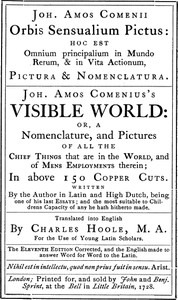
The Orbis Pictus by Johann Amos Comenius
Okay, let's be clear: this isn't a page-turner in the traditional sense. There's no plot twist on page 47. Instead, The Orbis Pictus (The Visible World in Pictures) is a guided tour of the entire 17th-century universe, from God and the elements to human trades, animals, and plants. Comenius organizes knowledge into 150 short chapters. Each one presents a woodcut illustration—like a scene of a garden, a kitchen, or a courtroom—and labels every item with a number. The facing page lists those numbers with their names in Latin and the reader's native language.
The Story
There's no narrative arc, but there is a powerful idea driving every page. Comenius was a bishop and teacher who lived through the Thirty Years' War. He saw chaos and believed education was the path to peace and piety. His 'story' is the journey from ignorance to understanding. The book starts with the world's creation and systematically builds your knowledge, moving from nature to human society. It's the ultimate 'show, don't tell' manual, making abstract concepts visible and tangible.
Why You Should Read It
It's humbling and fascinating. You see what a educated person 350 years ago was expected to know. The illustrations are charmingly detailed time capsules. But the real magic is feeling Comenius's voice—his firm belief that children are capable of great learning if we just present ideas clearly and connect them to the real world. He wanted to remove the 'drudgery' from school. Flipping through, you realize how many of his ideas (visual aids, bilingual teaching, starting with the familiar) are now standard practice.
Final Verdict
This is a treasure for anyone curious about the history of ideas, education, or publishing. It's perfect for teachers, parents, and history lovers who enjoy primary sources. Don't expect a thrilling yarn; come ready for a conversation with a gentle, brilliant mind from the past. It's less of a book to read cover-to-cover and more of a museum you can wander through, discovering the roots of how we learn.
The copyright for this book has expired, making it public property. Access is open to everyone around the world.
Anthony Lewis
1 year agoWithout a doubt, it challenges the reader's perspective in an intellectual way. Definitely a 5-star read.
Donald Hill
2 years agoThe layout is very easy on the eyes.
Brian Lee
1 year agoVery helpful, thanks.
Joshua Brown
1 year agoWithout a doubt, the emotional weight of the story is balanced perfectly. I would gladly recommend this title.
Lucas Scott
1 year agoText is crisp, making it easy to focus.