About 521 minutes
Memories of the Russian Court — Inside the Classic
Modern Nations
119,664 recorded words. 12 minutes difference from this book's estimate.
View Gutenberg source #59564
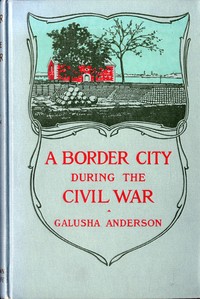
For The story of a border city during the Civil War — Reading Companion, the stored edition analysis reports 116,954 words, 8 hr 29 min estimated reading time, and 34 detected text sections.
The text analysis averages about 19.6 words per sentence, while the detected sections provide another way to judge how the source is divided.
Project Gutenberg metadata also associates the work with “Missouri -- History -- Civil War, 1861-1865,” connecting these edition facts with the source record’s subject description.
Explore this collection
These alternatives are selected using recorded categories and estimated reading time.
About 521 minutes
Modern Nations
119,664 recorded words. 12 minutes difference from this book's estimate.
View Gutenberg source #59564About 496 minutes
Modern Nations
114,043 recorded words. 13 minutes difference from this book's estimate.
View Gutenberg source #15301About 530 minutes
Modern Nations
121,733 recorded words. 21 minutes difference from this book's estimate.
View Gutenberg source #76599Search stored excerpts and compare books → Choose by your preferences →
Choices use stored catalog measurements. Estimates vary with reading speed. A shared category is a catalog label, not a claim that two books have the same argument or literary quality.
Search reads excerpt text stored with this catalog and links to its associated Gutenberg record. The connection is stored in the site database; this tool does not recheck that every excerpt is word-for-word identical to that external record. Excerpt search does not cover every chapter and does not verify historical publication dates.
Catalog snapshot checked: 2026-09-25. Coverage: 99 public books, 99 available source excerpts.
Read the complete public-domain text at its original source.
Read on Project GutenbergGalusha Anderson, a University of Chicago professor who lived in St. Louis from 1858 to 1866, wrote this account to portray "what transpired among us from 1860 to 1865." The book's dedication—"to all those, living or dead, who by wisdom, tact and self-sacrifice helped to keep Missouri in the Union"—signals its pro-Union stance, but Anderson claims to have weighed testimony from both sides. The catalog subjects list Missouri and St. Louis history during the Civil War, but the excerpts show a narrower focus: the political maneuvering and military tensions within the city, particularly the June 1861 conference at the Planters' Hotel.
Anderson explains that he was "frequently urged by men in different parts of the country to write out... the story of St. Louis during the Civil War." He notes that while his memories were "remarkably fresh," he had to "verify my recollections by wide reading and painstaking research." This dual role—participant and researcher—shapes the narrative. The excerpts show him citing specific sources, like a footnote referencing the conference, and acknowledging "conflicting testimony" on military operations. He aims to present "at least approximately, the historical facts," a cautious claim that distinguishes his work from a pure memoir.
The longest excerpt describes the June 11, 1861, conference between Union officers (General Lyon, Colonel Blair, Major Conant) and Missouri's governor. Anderson builds the scene with sensory details: Lyon spoke "deliberately, slowly and with peculiar emphasis," then rose, "pointing in turn to every one in the room," and finally "turned upon his heel and strode out... rattling his spurs and clanking his sabre." The dialogue is rendered dramatically, with Lyon's ultimatum—"rather than concede... I would see you, and you, and you... dead and buried"—presented as a direct quotation. This set piece exemplifies Anderson's method: vivid, partisan storytelling grounded in reported testimony.
The catalog subjects imply a broad history of Missouri and St. Louis during the war, but the excerpts reveal a tight focus on political and military events from a Unionist perspective. There is no mention of civilian life, economic conditions, slavery, or African American experiences. Anderson states his "sole object" is to portray "currents of thought and feeling" and "what was peculiar to us as a community made up of the loyal and disloyal." However, the excerpts do not show how he treats the disloyal viewpoint beyond acknowledging its existence. Readers should not expect a comprehensive social history from this sample.
Anderson's preface warns that he treats military operations "only in so far as they immediately affected the life and experiences of those within our city." Readers interested in the broader Civil War in Missouri should supplement this account with other sources. The book's value lies in its insider perspective on key events like the Planters' Hotel conference, filtered through a participant's memory and a historian's verification.
Sitting with Galusha Anderson’s account of St. Louis, I kept thinking about how a city’s quiet routines fracture under the weight of divided loyalties. That same ache—the slow unraveling of a familiar world—came back to me when I later found The History of the Highland Clearances Second Edition, Altered and Revised — Themes and Context. Both are stories of homes becoming strange, told by people who watched it happen.
Save your reaction, strongest insight, and memorable passage.