1

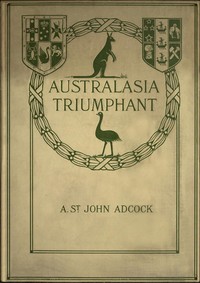
Australasia Triumphant!: With the Australians and New Zealanders in the Great War on Land and Sea — Text and Context
(0 User reviews)
87
Project Gutenberg
2021
Not confirmed
World War, 1914-1918 -- Naval operations; World War, 1914-1918 -- Campaigns -- Turkey -- Gallipoli Peninsula; World War, 1914-1918 -- Campaigns -- Egypt; World War, 1914-1918 -- Participation, Australian; World War, 1914-1918 -- Participation, New Zealand; World War, 1914-1918 -- Campaigns -- Pacific Ocean
Readers of public-domain and historical texts
Project Gutenberg digital edition
en
Edition facts
Words
35,001
Reading time
153 min
Text sections
10
The catalog record for Australasia Triumphant!: With the Australians and New Zealanders in the Great War on Land and Sea — Text and Context provides practical reading context through 35,001 words, 2 hr 33 min estimated reading time, and 10 detected text sections.
The text analysis averages about 32.8 words per sentence, while the detected sections provide another way to judge how the source is divided.
Project Gutenberg metadata also associates the work with “World War, 1914-1918 -- Naval operations,” connecting these edition facts with the source record’s subject description.
Source:
Project Gutenberg record #66658
A contemporary compilation of official dispatches, newspaper reports, and personal accounts chronicling Australian and New Zealand forces in WWI, focusing on the Suez Canal defense and Gallipoli campaign, with an emphasis on narrative voice and shifts in pacing.
Read the complete public-domain text at its original source.
Read on Project GutenbergArthur St. John Adcock's Australasia Triumphant! (1916) is a wartime compilation that weaves together official dispatches, newspaper reports, and personal letters to create a connected narrative of Australian and New Zealand involvement in the Great War. The author positions himself as an 'enthusiastic and faithful compiler,' drawing on sources such as Sir Ian Hamilton's dispatches and conversations with wounded Anzacs. The book's language oscillates between measured reportage and rousing patriotic fervor, reflecting the dual aim of documenting events and celebrating imperial loyalty.
Voice and Compilation Method
Adcock's narrative voice is that of a synthesizer rather than an eyewitness. He acknowledges the fragmentary nature of his sources—'one must read several accounts of the same event in order to get anything of an adequate idea of it'—and his prose often shifts between direct quotation and paraphrased summary. The author's own commentary is marked by elevated diction ('glorious heroism,' 'wonderful uprising') that frames the war as a test of national character. This voice is most prominent in the Author's Note, where he outlines his method, and in transitional passages that link disparate accounts.
Pacing in the Suez Canal Defense
The description of the Turkish attack on the Suez Canal (February 1915) demonstrates a deliberate shift in pace. Early paragraphs build tension through a series of failed attempts—boats 'deluged with shot and shell,' a makeshift bridge 'promptly went the same way of destruction.' The arrival of British warships accelerates the rhythm: 'having casually shattered the remnants of the pontoons, turned their guns on to the harassed lines of the enemy.' The subsequent retreat is rendered in a rapid, almost breathless catalog of abandoned equipment and casualties. This acceleration mirrors the tactical collapse of the Ottoman force.
Recurring Details and Structural Patterns
Adcock frequently employs the motif of light and darkness to mark transitions. The Turkish retreat begins 'only waited for the dark to come and hide his doings,' while the pursuit continues 'all through the night.' Such temporal markers recur across the excerpts, structuring the narrative around dawn and dusk. Another recurring detail is the emphasis on German officers commanding Ottoman troops—'their officers were mostly German'—which reinforces the book's framing of the war as a struggle against German militarism. These patterns, while not unique to this work, give the compilation a consistent thematic texture.
Readers should note that Australasia Triumphant! was published in January 1916, before many major battles involving ANZAC forces. The narrative thus reflects an early-war perspective, with limited information about later campaigns. Adcock's reliance on official and press sources means the book prioritizes strategic overviews over individual soldier experiences. For those interested in the evolution of wartime propaganda, this text offers a clear example of how contemporary compilations shaped public perception of colonial contributions.
I’ve often thought, shelving volumes after closing, how the clamor of Gallipoli in Australasia Triumphant! finds its quiet echo across the aisle. That book’s urgent dispatches—young men’s voices strained against the wire—settle strangely beside the measured reflections of German Problems and Personalities — Story, Setting & Ideas. Both whisper of nations learning who they are through ordeal. A shared patience, perhaps, in their different grammars of hope and ruin.
There are no reviews for this eBook.
There are no comments for this eBook.
Reader reflection
Your personal reading reflection
Build a private reading journal entry for this title.
Your progress
0
/
10
2
Was reading this book enjoyable?
3
Is this a title you would suggest to others?
4
Did the language feel accessible?
5
How well did it match your expectations?
6
Did this book create an emotional response?
7
Could you see yourself revisiting this book?
8
Did the book give you something worth debating?
9
In one sentence, what did you learn?
10