1

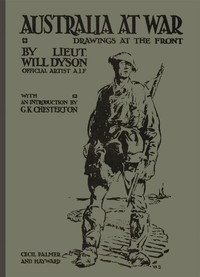
Australia at War A Winter Record Made by Will Dyson on the Somme and at Ypres, During the Campaigns of 1916 and 1917 — Text and Context
(0 User reviews)
839
Project Gutenberg
2018
Not confirmed
Australia. Australian Army. Australian Imperial Force (1914-1921); Australia. Australian Army. Australian Imperial Force (1914-1921) -- Pictorial works; World War, 1914-1918 -- Campaigns -- France -- Somme -- Pictorial works; World War, 1914-1918 -- Campaigns -- Belgium -- Ieper -- Pictorial works; World War, 1914-1918 -- Campaigns -- France -- Somme; World War, 1914-1918 -- Campaigns -- Belgium -- Ieper
Readers of public-domain and historical texts
Project Gutenberg digital edition
en
Edition facts
Words
9,773
Reading time
43 min
Text sections
3
The source record for Australia at War A Winter Record Made by Will Dyson on the Somme and at Ypres, During the Campaigns of 1916 and 1917 — Text and Context measures this digital text at 9,773 words, 43 min estimated reading time, and 3 detected text sections.
The text analysis averages about 26.0 words per sentence, while the detected sections provide another way to judge how the source is divided.
Project Gutenberg metadata also associates the work with “Australia. Australian Army. Australian Imperial Force (1914-1921),” connecting these edition facts with the source record’s subject description.
Source:
Project Gutenberg record #57177
Will Dyson's drawings and notes from the Somme and Ypres winters of 1916-1917, introduced by G. K. Chesterton, capture the misery and depression of war through a caricaturist's eye, focusing on the physical and emotional toll on soldiers.
Read the complete public-domain text at its original source.
Read on Project GutenbergWill Dyson, known as a caricaturist, turns his eye to the Western Front in this collection of drawings and accompanying notes from the winters of 1916 and 1917 on the Somme and at Ypres. The work is introduced by G. K. Chesterton, who notes Dyson's own wounding in the war. Dyson's artist's note explicitly states that the selection reflects 'the misery and the depression of the material conditions' rather than any exaltation or cheerfulness, a choice he defends by questioning whether soldiers saving the world should also provide light entertainment.
A Caricaturist's Vision of War
Dyson's background as a caricaturist shapes his approach to depicting war. Chesterton's introduction emphasizes this, noting that Dyson was 'probably the most original caricaturist of our time.' The drawings are not literal records but interpretative sketches that exaggerate and distill the grim reality. Dyson's dedication poem, addressed to the men of the A.I.F., uses striking imagery: they are 'like cave men rough-hewn of the mud,' and their work is 'the work of wolves.' This poetic voice, blending the primal with the mechanical, sets the tone for the visual and textual content that follows.
The Weight of Mud and Memory
The excerpts reveal a world defined by mud and exhaustion. Dyson describes stretcher-bearers moving 'like boats on a slowly tossing sea, rising and falling with the shell riven contours' of no man's land. The physical environment is relentless: 'the downward suck of the Somme mud' wears heels raw. Yet Dyson insists on the inner struggle, rejecting the idea that soldiers are mere mechanisms. He writes that their heroism lies in 'inclinations conquered and panics subdued down in the privacy of the soul.' The men are not heroes from choice but because 'someone has got to be heroic.'
Moments of Grim Routine
Amid the larger tragedy, Dyson captures small, telling details of soldier life. In 'Waiting for the Stew,' a delay in food delivery becomes a crisis: 'the dreadful possibility of going in without that stew began to haunt the strongest and the bravest.' The arrival of strays after midnight, 'in ones and twos and threes,' and their gathering around cookers 'that shone like lode stars in the gloom' shows a fragile sociability. Dyson notes that stories told in these moments may never be repeated, as 'the civilian habit of mind reasserts itself' and soldiers become reticent about their experiences.
Dyson's work offers a view of war that is unflinching yet deeply human, focusing on the physical and psychological weight carried by soldiers. Readers should approach the drawings and notes as a deliberate counterpoint to more heroic or sanitized accounts, one that insists on the reality of suffering and the quiet endurance required to face it. The combination of visual art and written reflection creates a layered record of a specific winter of war.
That winter in Dyson’s sketches—the mud, the silence between men—stays with me on grey afternoons. I remember tracing his lines and thinking about endurance, then wandering to a shelf where The Spirit of Lafayette — Background and Themes sat waiting. It wasn’t a plan; just the same quiet question of what keeps a person standing when everything else has gone.
There are no reviews for this eBook.
There are no comments for this eBook.
Reader reflection
Your personal reading reflection
Build a private reading journal entry for this title.
Your progress
0
/
10
2
Was reading this book enjoyable?
3
How likely are you to recommend this book?
4
How much effort did this book require?
5
How distinctive were its ideas or approach?
6
Could you follow the author’s main argument?
7
Did this book create an emotional response?
8
Would you like to discuss this book with someone?
9
Which lesson or insight stayed with you?
10