1

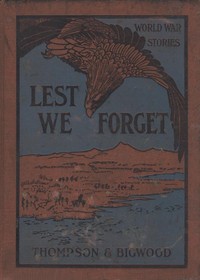
Lest We Forget: World War Stories — Text and Context
(0 User reviews)
1247
Project Gutenberg
2011
Not confirmed
Readers -- World War, 1914-1918; Readers -- History
Readers of public-domain and historical texts
Project Gutenberg digital edition
en
Edition facts
Words
83,904
Reading time
365 min
Text sections
12
Before opening Lest We Forget: World War Stories — Text and Context, the edition data offers a quick orientation: 83,904 words, 6 hr 5 min estimated reading time, and 12 detected text sections.
The text analysis averages about 22.3 words per sentence, while the detected sections provide another way to judge how the source is divided.
Project Gutenberg metadata also associates the work with “Readers -- World War, 1914-1918,” connecting these edition facts with the source record’s subject description.
Source:
Project Gutenberg record #36634
An editorial note on the language, narrative voice, and changes in pace in 'Lest We Forget: World War Stories' by John Gilbert Thompson and Inez Bigwood, a 1918 reader for upper grammar grades compiling heroic tales and primary documents from World War I.
Read the complete public-domain text at its original source.
Read on Project GutenbergThe preface to Lest We Forget: World War Stories frames the book as a deliberate pedagogical tool, aiming to guide “youthful readers who are beginning to think for themselves” through tales of heroism and sacrifice. The authors, John Gilbert Thompson and Inez Bigwood, explicitly state that the volume is “prepared to meet this important need,” positioning the stories as both historical record and moral instruction. The language throughout the excerpts shifts between formal, declarative narration and the raw, first-person testimony of survivors, creating a tension between editorial control and authentic witness.
A Dual Voice: Editorial Framing and Eyewitness Testimony
The book’s structure juxtaposes two distinct registers. The preface and chapter headings use a measured, authoritative tone: “great care has been employed to secure accuracy of fact.” In contrast, the survivor accounts—such as William Snell’s deposition—employ plain, sensory detail: “I hugged the life belt close to my breast with one arm.” This shift from third-person summary to first-person immediacy alters the reading experience, pulling the reader from detached overview into the chaos of a sinking ship. The editorial voice frames the events as exemplary, while the witness voice resists that framing through its unadorned, moment-by-moment report.
Pace and Suspense in the Survivor Narratives
The longest excerpt, a sailor’s account of the Belgian Prince sinking, demonstrates a deliberate change in pace. Short, declarative sentences mark the initial crisis: “We had no means of escape.” As the narrative continues, the rhythm slows with accumulating detail: “The water kept on rising around my legs, and when it got almost up to my knees I pulled out my life belt.” The repetition of temporal markers—“all this time,” “when dawn broke,” “pretty soon”—builds a sense of duration and dread. The pace accelerates again at the moment of action: “I jumped overboard. The other men didn’t seem to know what was going to happen.” This variation mirrors the psychological experience of waiting, then acting.
Recurring Motifs and Stylized Openings
Several structural patterns recur across the excerpts. The book opens with Kipling’s “Recessional,” its refrain “Lest we forget” serving as both title and thematic anchor. The preface employs a rhetorical pattern of contrast: “Little or no thought seems to have been given to youthful readers … much has been done for adults.” The witness accounts frequently use the phrase “I began to” to mark a shift from observation to action. The submarine commander is described as “a blond man with blue eyes,” a detail that echoes in other survivor testimony, suggesting a shared visual memory. These repeated elements create a cohesive texture across the varied sources.
Readers attentive to shifts in register will notice how the editors’ framing often simplifies the moral complexity of the eyewitness accounts. The survivor stories resist easy closure—Snell’s narrative ends not with a lesson but with a question: “I wonder if they mean to drown us.” Paying attention to these moments of unresolved tension reveals the book’s deeper engagement with the chaos of war, beyond its stated aim of inspiring heroism.
My grandfather kept a copy of this 1918 reader on his shelf, and I remember the odd stillness of those heroic tales—so certain, so far from my own doubts. Reading the editorial note about its shifts in pace, I recalled sitting with The Achievement of the British Navy in the World-War — Inside the Classic years later, the same strange quiet settling over me, as if both books spoke from a world that had already finished believing.
There are no reviews for this eBook.
There are no comments for this eBook.
Reader reflection
How did this book work for you?
Your answers remain private and are stored only in this browser.
Your progress
0
/
10
2
What was your overall reaction to the book?
3
How likely are you to recommend this book?
4
How much effort did this book require?
5
How original did the book feel?
6
Would you read this book again?
7
Did you gain anything practical from the text?
8
What was its emotional impact?
9
What did this book teach you most?
10