1

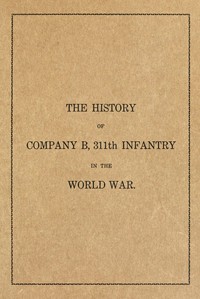
The history of Company B, 311th Infantry in the World War — Context and Discussion
(0 User reviews)
1591
Project Gutenberg
2022
Not confirmed
World War, 1914-1918 -- Regimental histories -- United States; United States. Army. Infantry. 311th regiment, 1917-1919. Co. B
Readers of public-domain and historical texts
Project Gutenberg digital edition
en
Edition facts
Words
62,546
Reading time
272 min
Text sections
24
The history of Company B, 311th Infantry in the World War — Context and Discussion can be approached with a clearer sense of reading commitment from its source measurements: 62,546 words, 4 hr 32 min estimated reading time, and 24 detected text sections.
The text analysis averages about 13.2 words per sentence, while the detected sections provide another way to judge how the source is divided.
Project Gutenberg metadata also associates the work with “World War, 1914-1918 -- Regimental histories -- United States,” connecting these edition facts with the source record’s subject description.
Source:
Project Gutenberg record #68333
Editor B. A. Colonna's firsthand account of Company B, 311th Infantry in World War I, blending official rosters and casualty lists with personal narrative that reveals the gap between catalog subjects and the visceral, fragmented experience of combat.
Read the complete public-domain text at its original source.
Read on Project GutenbergColonna opens his introduction by addressing his comrades directly, admitting his 'small gift of expression' and promising to 'put down everything as it occurred.' This personal pledge sets the tone for a history that is less a dry regimental record and more a memoir of a unit he calls 'a living and vital being.' The catalog subjects list this as a regimental history, but the excerpts show a narrator who writes in the first person, describes a German soldier's 'high, whip-like crack' of a rifle, and recounts his own wound with detached irony. The book includes extensive rosters and statistics, yet the narrative voice consistently undercuts any official distance.
First-Person Combat and Catalog Categories
The catalog classifies this work under 'Regimental histories,' but the excerpts reveal a narrator who rejects impersonality. Colonna writes, 'I am writing in the first person. The best I can do is to relate things as I saw them.' This choice transforms the history into a subjective account. In one passage, he mistakes a German soldier for a runner, noting 'how nicely his helmet came down around his neck' before a bullet cracks past his ear. Such details—the visual quirk, the near-death moment—are absent from typical unit histories. The book's structure, with chapters titled 'St. Mihiel and Limey Sector' and 'Meuse-Argonne,' suggests a chronological campaign record, but the narrative dwells on confusion: patrols lost, runners not returning, and the 'peculiar detachment' of combat. The catalog's tidy subject headings do not capture this chaos.
Voice and the Limits of Official Record
Colonna's voice is conversational and self-deprecating. He describes reaching for his .45 pistol, remembering 'my last target score with that weapon,' and then running. This honesty undercuts any heroic pose. The book includes 'Alphabetical Roster of Enlisted Men' and 'Lists of Casualties,' but the narrative shows how those lists are made: a wounded soldier named Roy is placed on a stretcher, though shells are still bursting, and 'that gallant spirit breathed its last before they had gone a kilometer.' The official record reduces Roy to a name; the narrative gives him a moment. Colonna also admits memory gaps: 'their names I can't recall, though their faces stand out sharply.' The roster supplies the names, but the story supplies the faces. The tension between the two forms—list and story—is central to the book.
Setting and Sensory Detail in the Excerpts
The excerpts are rich with sensory specifics that ground the narrative in a particular place and time. Colonna notes the sound of German rifles: 'a high, whip-like crack, easily distinguishable from that of our Enfield or Springfield.' He describes the woods as so thick that 'we couldn't see fifty yards through the woods.' Movement is cautious: 'a few yards at a time, stopping to look and listen.' The enemy's withdrawal is marked by 'clumping and crashing along, and shouting to one another.' These details create a textured environment absent from the catalog's abstract subjects. The setting is not just 'Meuse-Argonne' but a specific ridge, ravine, and clump of bushes where a soldier named Price holds a position. The book's chapters may list sectors, but the excerpts show a landscape of limited visibility and acoustic cues.
Readers should approach this history as a hybrid: part official record, part personal testimony. The rosters and casualty lists provide a skeleton, but Colonna's narrative gives it flesh. Pay attention to moments where the editor admits uncertainty or shifts from 'we' to 'I'—these are where the book departs from the regimental history genre. The excerpts suggest that the most valuable parts may be the small, confused encounters that official records omit.
I keep coming back to how Colonna’s roster of names never quite matches the mud and noise he describes between the lines. Those boys stay catalogued, yet the real story lives in the gaps. Reading 'Hello, soldier!' — Edition Insights brought that same ache back—the way a greeting can hold both a hello and a goodbye at once.
There are no reviews for this eBook.
There are no comments for this eBook.
Reader reflection
Your personal reading reflection
Build a private reading journal entry for this title.
Your progress
0
/
10
2
How did the book work for you overall?
3
How likely are you to recommend this book?
4
How demanding did the text feel?
5
Is this a title worth rereading?
6
How strongly did the book affect you emotionally?
7
How useful did the reading feel?
8
Did anything about the book feel genuinely new?
9
What did this book teach you most?
10