1

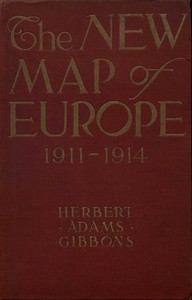
The New Map of Europe (1911-1914) The Story of the Recent European Diplomatic Crises and Wars and of Europe's Present Catastrophe — Reading Notes
(0 User reviews)
634
Project Gutenberg
2017
Not confirmed
World War, 1914-1918 -- Causes; Eastern question (Balkan); Europe -- Politics and government -- 1871-1918; Competition, International
Readers of public-domain and historical texts
Project Gutenberg digital edition
en
Edition facts
Words
108,943
Reading time
474 min
Text sections
11
For The New Map of Europe (1911-1914) The Story of the Recent European Diplomatic Crises and Wars and of Europe's Present Catastrophe — Reading Notes, the stored edition analysis reports 108,943 words, 7 hr 54 min estimated reading time, and 11 detected text sections.
The text analysis averages about 22.5 words per sentence, while the detected sections provide another way to judge how the source is divided.
Project Gutenberg metadata also associates the work with “World War, 1914-1918 -- Causes,” connecting these edition facts with the source record’s subject description.
Source:
Project Gutenberg record #54082
This 1914 study examines European diplomatic crises from 1911 to 1914, focusing on Balkan wars, great power rivalries, and the Ottoman Empire's disintegration, based on the author's firsthand observations.
Read the complete public-domain text at its original source.
Read on Project GutenbergHerbert Adams Gibbons opens his account with a personal anecdote: on a July day in 1908, he and his wife, honeymooning in Oxford, heard a newsboy cry out news of the Young Turk revolution. Within two weeks they were sailing into Smyrna harbor, surrounded by returning exiles. This blend of scholarly analysis and eyewitness reporting defines The New Map of Europe (1911–1914). Gibbons, who had lived in the Ottoman Empire and traveled through the Balkans, writes not as a detached historian but as a journalist-diplomat who watched crises unfold. The book’s catalog subjects—World War causes, the Eastern Question, European politics, and international competition—are all addressed, but the excerpts reveal a work more concerned with the internal dynamics of the Ottoman state and the Balkan states than with great-power diplomacy alone.
Eyewitness to Empire in Crisis
Gibbons repeatedly grounds his analysis in scenes he witnessed. In Uskub, four weeks before the First Balkan War, he spoke with Albanian chieftains who had made a truce for Ramazan. They told him that if the Turks did not stop persecuting them, they would march on Constantinople. Gibbons uses this encounter to argue that the Ottoman army’s poor performance against the Balkan League stemmed from years of exhausting campaigns against Albanian rebels. He notes that the Balkan states knew how severely the western Macedonian army had suffered in July and August 1912, and that this knowledge helped decide their timing. Such details—a conversation in a specific place at a specific moment—give the book a texture absent from purely archival histories.
The Young Turks’ Missteps in Albania and Arabia
Gibbons is sharply critical of the Young Turk regime. He describes their attempt to disarm Albanians by sending rapid-firing guns and burning villages, calling it a poor argument for compliance. “Under ordinary circumstances an Albanian would rather lose his leg than his gun,” he writes. The rebellion broke out afresh every year, exhausting Ottoman resources. In Asiatic Turkey, Gibbons estimates eight million Arabic-speaking inhabitants, though he admits no census exists. He argues that the Arabs were never assimilated: their language enriched Turkish with Arabic substantives, but racial fusion did not occur. The Sultan’s authority as Khalif was respected only in form; an aggressive pasha could easily detach Egypt. These observations connect the catalog subject “Eastern question (Balkan)” to the empire’s broader fragility.
Structure and Scope: From Algeciras to the Ultimatum
The table of contents shows a work organized chronologically and thematically, moving from Germany’s ambitions (Alsace-Lorraine, Weltpolitik, the Baghdad Railway) through crises in Persia, Poland, and Italy, then to the Balkan Wars and the July 1914 ultimatum. The final chapters trace how Germany forced war on Russia and France, and Britain’s entry. Yet the excerpts focus almost entirely on the Ottoman Empire and the Balkans; the great-power sections are not represented. This imbalance may reflect the author’s expertise—he wrote a previous book on the Ottoman Empire—or the incomplete nature of the excerpts. Readers should note that the catalog subject “Competition, International” likely receives fuller treatment in chapters not included here.
Gibbons dedicated the book to his three children, born in Adana, Constantinople, and Paris “in the midst of the wars and changes that this book describes.” That personal note underscores the work’s immediacy. Readers interested in the origins of World War I will find a perspective grounded in the Ottoman collapse and Balkan nationalism, not just the July Crisis. The book is best approached as a contemporary analysis—sometimes opinionated, always engaged—rather than a detached retrospective.
Watching the empires of 1914 collapse in that old atlas, I was reminded of Carlyle’s pages on the Bastille’s fall. Both books whisper of the same terrible patience found in human structures—how a world can seem so solid, until the weight of its own contradictions quietly brings it all down. The French Revolution: A History — Reading Notes never left my shelf beside it.
There are no reviews for this eBook.
There are no comments for this eBook.
Reader reflection
How will you remember this book?
Save your reaction, strongest insight, and memorable passage.
Your progress
0
/
10
2
Was reading this book enjoyable?
3
How likely are you to recommend this book?
4
What was the reading difficulty like?
5
How original did the book feel?
6
Would you like to discuss this book with someone?
7
Which aspect of the book did you value most?
8
How much did the book move you?
9
What is the main idea you are taking away?
10