1

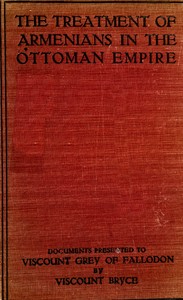
The treatment of Armenians in the Ottoman Empire Documents presented to Viscount Grey of Fallodon — Story, Setting & Ideas
(0 User reviews)
782
Project Gutenberg
2022
Not confirmed
World War, 1914-1918 -- Atrocities; Armenian question; Armenians; World War, 1914-1918 -- Refugees
Readers of public-domain and historical texts
Project Gutenberg digital edition
en
Edition facts
Words
306,650
Reading time
1334 min
Text sections
53
This digital edition of The treatment of Armenians in the Ottoman Empire Documents presented to Viscount Grey of Fallodon — Story, Setting & Ideas is described by source-level measurements including 306,650 words, 22 hr 14 min estimated reading time, and 53 detected text sections.
The text analysis averages about 20.6 words per sentence, while the detected sections provide another way to judge how the source is divided.
Project Gutenberg metadata also associates the work with “World War, 1914-1918 -- Atrocities,” connecting these edition facts with the source record’s subject description.
Source:
Project Gutenberg record #69630
A 1916 official British documentary collection on the Armenian genocide, edited by Arnold Toynbee with a preface by Viscount Bryce, presenting eyewitness accounts, diplomatic correspondence, and refugee testimonies to expose systematic atrocities in the Ottoman Empire during World War I.
Read the complete public-domain text at its original source.
Read on Project GutenbergThis 1916 volume, presented to Foreign Secretary Viscount Grey, is a documentary record compiled by historian Arnold Toynbee and introduced by Viscount Bryce. It assembles eyewitness reports, diplomatic dispatches, and survivor testimonies to document the systematic destruction of Armenian communities in the Ottoman Empire. The work was laid before Parliament as an official paper, signaling its intended role as evidence for policy and public accountability.
The excerpts reveal a structure built on corroboration: neutral sources, missionary letters, and refugee interviews are juxtaposed to create a cumulative case. One account describes the fighter Murad of Sivas, whose escape from Turkish forces to Batoum is narrated in vivid, tactical detail—a rare first-person survival story amid the broader pattern of massacre and displacement.
Eyewitness Testimony and the Refugee Voice
The collection foregrounds direct testimony from survivors, such as the interview with Murad of Sivas recorded at Tiflis. His account—detailing an eight-day siege on Yaldiz Dagh, a forced sailing vessel capture, and a chase by Turkish motor launches—offers a granular, tactical narrative absent from official summaries. The editor’s decision to include such personal stories alongside neutral dispatches (e.g., a despatch from an “especially well-informed neutral source at Constantinople”) creates a layered evidentiary record. The refugee is not merely a statistic but a named actor: Murad is identified as a “brother-in-arms of Andranik,” linking his story to organized Armenian volunteer regiments. This interplay between individual agency and systemic violence is a recurring structural pattern.
The Documentary Architecture of Atrocity
The volume’s table of contents reveals a deliberate taxonomy: sections are organized by region (e.g., Sivas, Harpout, Dersim), and documents are classified by type—despatches, letters, interviews. The editor’s memorandum and a preface by Bryce frame the material as evidence for a political audience. Notably, the contents page distinguishes between documents that “relate merely to the condition of refugees” and those that detail “events in Turkey and N.W. Persia,” signaling a hierarchy of evidentiary weight. This structure mirrors legal or diplomatic briefing, emphasizing corroboration through multiple sources: American correspondents, German missionaries, and Armenian survivors. The inclusion of a letter from four German missionaries to the Berlin Foreign Office adds a dimension of international witness, complicating any simple Allied-versus-Central-Powers narrative.
Contrasts in Narrative Scale and Tone
The excerpts display sharp contrasts in scale and voice. The Murad narrative is intimate and episodic, focusing on a single band’s movements, skirmishes, and the death of a comrade named Yegho. In contrast, the general descriptions from Constantinople adopt a panoramic, analytical tone, reporting on deportations and massacres across provinces. The editor’s hand is visible in the juxtaposition: a neutral source’s dispatch dated 11 June 1915 sits alongside a letter from Arabkir dated 25 June/8 July 1915, creating a temporal and geographical mosaic. The reader moves from the strategic overview of an American correspondent to the visceral detail of a survivor’s escape—a shift that underscores the gap between official knowledge and lived experience. This editorial choice forces the audience to reconcile abstract atrocity with concrete human cost.
Readers approaching this collection should attend to its dual function: as a historical source and as a contemporary political instrument. The documents are not neutral records but selected, translated, and arranged to persuade. Noting the provenance of each item—whether from a missionary, a refugee, or a diplomat—helps assess its perspective. The volume rewards careful comparison between accounts, revealing both corroboration and dissonance in the testimony of atrocity.
I keep thinking about that 1916 collection—how quietly it forces you to sit with what people witnessed. There’s no drama in the telling, just documents, and somehow that makes it heavier. A friend later handed me The Way to Win — Context and Discussion, and it felt like the same kind of companionable weight, less about answers and more about noticing how we frame what happened. That stayed with me, the framing itself.
There are no reviews for this eBook.
There are no comments for this eBook.
Reader reflection
How did this book work for you?
Your answers remain private and are stored only in this browser.
Your progress
0
/
10
2
How did the book work for you overall?
3
Would you recommend this book to another reader?
4
What was the reading difficulty like?
5
Did it raise ideas you would like to talk about?
6
Could you see yourself revisiting this book?
7
What was its emotional impact?
8
How did the pace of the book feel?
9
What did this book teach you most?
10