1

The United States Marine Corps in the World War — Inside the Classic
(0 User reviews)
459
Project Gutenberg
2023
Not confirmed
World War, 1914-1918 -- United States; United States. Marine Corps -- History -- World War, 1914-1918
Readers of public-domain and historical texts
Project Gutenberg digital edition
en
Edition facts
Words
37,587
Reading time
164 min
Text sections
35
The catalog record for The United States Marine Corps in the World War — Inside the Classic provides practical reading context through 37,587 words, 2 hr 44 min estimated reading time, and 35 detected text sections.
The text analysis averages about 17.6 words per sentence, while the detected sections provide another way to judge how the source is divided.
Project Gutenberg metadata also associates the work with “World War, 1914-1918 -- United States,” connecting these edition facts with the source record’s subject description.
Source:
Project Gutenberg record #70782
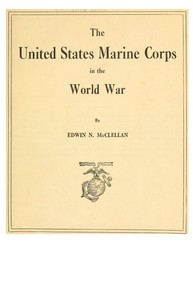
A concise official history of the U.S. Marine Corps in World War I, compiled by Major Edwin N. McClellan from Marine Corps records, detailing the Fourth Brigade's battles, organization, and statistics without personal commentary.
Read the complete public-domain text at its original source.
Read on Project GutenbergThis official history, compiled by Major Edwin N. McClellan while serving as Officer in Charge of the Historical Division, presents a deliberately restrained account of the Marine Corps in the First World War. The author states that the work is “preliminary to the final and detailed history” and that “every effort has been made to avoid expressions of opinions and criticisms.” The text thus functions as a documentary record rather than a narrative, relying on tables, orders, and official correspondence. Readers will find a wealth of specific data—enlistments by state, unit movements, and casualty figures—but little in the way of personal anecdote or strategic analysis.
A Documentary Rather Than Narrative Approach
The book’s structure reflects its origin as an official compilation. The table of contents lists chapters on statutory strength, recruiting, geographical location, and operations, but the excerpts show that much of the text consists of reproduced orders, letters of transmission, and tabular data. For example, the “Letter of Transmission” from McClellan to the Major General Commandant is included verbatim, along with endorsements from senior officers. The summary of the Fourth Brigade’s operations is presented as a list of sectors and dates “as published in General Orders No. 37, Second Division.” This reliance on official documents means the reader encounters the war through administrative channels rather than through a unified authorial voice.
The Fourth Brigade’s Battle Record in Official Language
The excerpts include a detailed summary of the Fourth Brigade’s participation in battles, from the Toulon sector in March 1918 to the Meuse-Argonne offensive. The language is formal and understated: the brigade “participated in actual battle in France in the following sectors.” A letter from the commanding general of the Army of Occupation praises the division’s “splendid achievements,” citing actions at Belleau Wood, Soissons, Blanc Mont Ridge, and the Meuse crossing. Notably, the letter uses the phrase “shock troops” to describe the division’s role. The history itself, however, does not embellish these events; it simply records the official commendation.
Personnel Changes and Command Structure
The text meticulously tracks officer assignments and promotions. For instance, it notes that “Maj. Charles D. Barrett relieved Lieut. Col. Earl H. Ellis as brigade adjutant in April, 1919,” and that “Col. Logan Feland was temporarily appointed brigadier general to rank from March 9, 1919.” Such details reveal the fluid command structure during demobilization. The inclusion of exact dates and orders—such as the reference to “General Orders, Second Division, No. 68, July 5, 1919”—demonstrates the author’s commitment to verifiable documentation. Readers interested in administrative history will find a precise record of who commanded what and when.
Because this history is explicitly preliminary and avoids interpretation, it serves best as a reference for facts and official documents rather than as a narrative history. Readers seeking a broader understanding of the Marine Corps’ role may need to supplement this text with other sources. The work’s value lies in its raw data and the clear chain of command it preserves, offering a foundation for further study.
The rain kept drumming on the windowsill while I finished McClellan’s dry, factual pages on the Fourth Brigade. Its stillness led me, almost by accident, to The Way to Win — Context and Discussion, which felt like stepping into a quiet room where someone finally explained the shadows those official records left untouched. I remember reading late into the grey afternoon.
There are no reviews for this eBook.
There are no comments for this eBook.
Reader reflection
What did you think of this book?
Answer a few questions and save a private reflection on this device.
Your progress
0
/
10
2
Was reading this book enjoyable?
3
Is this a title you would suggest to others?
4
What was the reading difficulty like?
5
Is this a title worth rereading?
6
Which element worked best for you?
7
What was its emotional impact?
8
Could you follow the author’s main argument?
9
What is the main idea you are taking away?
10