1

The Vampire of the Continent — Themes and Context
(0 User reviews)
65
Project Gutenberg
2021
Not confirmed
World War, 1914-1918 -- Causes; Great Britain -- Foreign relations -- Germany; Germany -- Foreign relations -- Great Britain; Great Britain -- Foreign relations
Readers of public-domain and historical texts
Project Gutenberg digital edition
en
Edition facts
Words
58,565
Reading time
255 min
Text sections
17
The Vampire of the Continent — Themes and Context can be approached with a clearer sense of reading commitment from its source measurements: 58,565 words, 4 hr 15 min estimated reading time, and 17 detected text sections.
The text analysis averages about 25.9 words per sentence, while the detected sections provide another way to judge how the source is divided.
Project Gutenberg metadata also associates the work with “World War, 1914-1918 -- Causes,” connecting these edition facts with the source record’s subject description.
Source:
Project Gutenberg record #66468
A 1916 German polemic, translated for American readers, arguing that England's 'Will to Power' drove European conflicts from the 16th century to WWI. The excerpts reveal a systematic indictment of British foreign policy, with recurring metaphors of vampirism and predation, though the full argument is only partially sampled.
Read the complete public-domain text at its original source.
Read on Project GutenbergCount Ernst zu Reventlow's The Vampire of the Continent, published in 1916 and translated by Georges Chatterton-Hill, presents a sustained German nationalist argument that England is the primary aggressor in European history. The translator's preface frames the work as 'the first systematic attempt to go to the root of things,' claiming that all major European developments since the sixteenth century can be traced to 'England's Will to Power.' The excerpts show a polemical structure that moves chronologically from the 'Heroic Age of the Britons' through the Napoleonic Wars to the immediate pre-war period, with each chapter intended to demonstrate British duplicity and expansionism.
Metaphor as Argument: The Vampire and the Predator
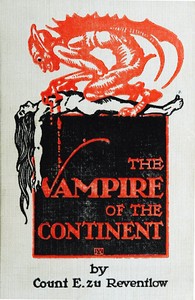
The title's central metaphor is deployed explicitly in the translator's preface, which describes England's 'insatiable greed' and 'limitless craving for the riches of this world.' The excerpts show this imagery extended through repeated characterizations of British actions as parasitic: England 'succeeded in utilising her enemy against Russia' in the Crimean War, and later 'enticed France into the Mexican adventure, and then, as usual, retired from the scene herself.' The language of predation is consistent—England 'did and took what she wanted,' and if territory 'appealed to the taste of some wandering English merchant or politician, he simply hoisted the British flag.' This rhetorical pattern frames British policy as inherently opportunistic and amoral, a charge the author supports with selected historical episodes rather than systematic evidence.
Selective History and the Charge of Manipulation
The excerpts reveal a method of historical argument that emphasizes British manipulation of other powers. Reventlow claims that 'in London the thread was spun of an elaborate intrigue' to prevent German unification, and that British statesmen 'observed with satisfaction' Napoleon III's weakening position. The narrative attributes agency almost exclusively to England: 'The far-sightedness of English statesmen had recognised, early already in the sixties, that the power of Napoleon was on the wane.' Other nations appear as pawns—France is 'induced' to sacrifice troops, the Khedive is 'overburdened with debts,' and Bismarck alone is credited with resisting British designs. This selective focus, while rhetorically effective, omits the internal dynamics and agency of other states, a limitation the excerpts do not acknowledge.
Translation and Audience: The American Edition
The translator's preface explicitly addresses an American readership, presenting the work as 'a considerably abridged English edition' intended to provide 'insight into the hidden recesses of European political history.' The choice to abridge suggests an awareness of the original's length (over 58,000 words) and a desire to make the argument more accessible. The translator, Georges Chatterton-Hill, holds a Ph.D. and frames the work as scholarly, though the excerpts show a polemical rather than academic tone. The American edition was published by The Jackson Press in New York in 1916, during World War I but before U.S. entry, positioning it as a contribution to contemporary debate over the war's causes. The catalog subjects—'World War, 1914-1918 -- Causes' and 'Great Britain -- Foreign relations -- Germany'—reflect this intent, though the excerpts focus on earlier centuries.
Readers should approach The Vampire of the Continent as a primary source for understanding German nationalist interpretations of history during World War I, rather than as an objective historical account. The excerpts demonstrate a consistent rhetorical strategy of attributing European conflicts to British machinations, but the full text would need to be examined to assess how Reventlow handles counterarguments or evidence that complicates his thesis. The work's value lies less in its historical accuracy than in its representation of wartime propaganda and the intellectual frameworks used to justify German policy.
Reading the old German polemic, with its sharp talk of predatory empires, made me think of that other volume waiting on my shelf, Italy at war and the Allies in the West — A Closer Reading. Where the one rages, the other simply observes. I found myself drifting between them, the accusation and the aftermath, each softening the other’s edges like dusk settling over a long argument.
There are no reviews for this eBook.
There are no comments for this eBook.
Reader reflection
What did you think of this book?
Answer a few questions and save a private reflection on this device.
Your progress
0
/
10
2
Did this book hold your interest?
3
How likely are you to recommend this book?
4
What was the reading difficulty like?
5
How clearly were the main ideas presented?
6
How valuable was this book for your own interests?
7
How closely did the book connect with your experience?
8
How much did the book move you?
9
In one sentence, what did you learn?
10