1

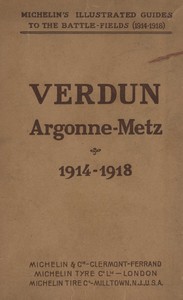
Verdun, Argonne-Metz, 1914-1918 — Key Ideas to Explore
(0 User reviews)
24
Project Gutenberg
2015
Not confirmed
World War, 1914-1918 -- Campaigns -- France; World War, 1914-1918 -- Battlefields -- Guidebooks; Historic sites -- France -- Guidebooks; Battlefields -- France -- Guidebooks
Readers of public-domain and historical texts
Project Gutenberg digital edition
en
Edition facts
Words
41,678
Reading time
182 min
Text sections
8
Verdun, Argonne-Metz, 1914-1918 — Key Ideas to Explore can be approached with a clearer sense of reading commitment from its source measurements: 41,678 words, 3 hr 2 min estimated reading time, and 8 detected text sections.
The text analysis averages about 18.0 words per sentence, while the detected sections provide another way to judge how the source is divided.
Project Gutenberg metadata also associates the work with “World War, 1914-1918 -- Campaigns -- France,” connecting these edition facts with the source record’s subject description.
Source:
Project Gutenberg record #48185
A Michelin guide to the Verdun, Argonne, and Metz battlefields, blending detailed itineraries with accounts of combat, terrain, and memorials. The text juxtaposes precise topography—ravines, quarries, ridges—with sudden episodes of capture, surrender, and artillery fire, revealing how the landscape was both stage and casualty of war.
Read the complete public-domain text at its original source.
Read on Project GutenbergThis Michelin guide to the battlefields of Verdun, Argonne, and Metz is neither a conventional travel book nor a dry military history. It is a hybrid: a route-by-route itinerary that directs the reader’s eye to specific ravines, quarries, and ridges, while simultaneously recounting the actions that unfolded there. The text moves from the political origins of Verdun as a Roman fortress to the churned soil of Nawé wood, where “not even the stumps remain.” The guide’s voice is matter-of-fact, yet the details it selects—a wrecked train at the foot of Poivre Hill, a sergeant capturing a company single-handedly—give the landscape a charged, anecdotal density.
Landscape as Archive
The guide treats terrain as a record of violence. It notes that Haudromont Quarries have “steep white walls” that “show up against the clay of the hill,” then explains how the enemy cut galleries in the stone “proof against the heaviest shells.” The physical features are never neutral: a ravine is a site of encirclement, a slope is a pivot for an entire line. The text repeatedly points out what is no longer there—Nawé wood’s stumps are gone, the soil “churned up” by shell-holes. This is a landscape that has been rewritten by artillery, and the guide functions as a key to reading its scars.
Sudden Captures and Quiet Heroics
Amid the topographical detail, the guide inserts brief, vivid vignettes of combat. At Haudromont Quarries, the 11th Infantry Regiment advanced “singing” and surrounded the defenders, fighting with bombs in the galleries until evening. On Poivre Hill, three columns of the 112th Line Regiment “rushed this fortress” in a surprise attack that captured German officers “as they were getting out of their” quarters. Sergeant Julien of the 4th Zouaves, captured during a ration party, “took a high tone” and persuaded a company and six officers to surrender. These episodes are not heroic set-pieces; they are presented as matter-of-fact occurrences, their brevity underscoring the unpredictability of battle.
The Guide as Memorial Fundraiser
The opening pages reveal that this book was also a fundraising tool. A full-page appeal promotes the Mortuary of Douaumont, a memorial to the 400,000 French soldiers who fell on a front of 20 kilometres. The committee includes Marshal Pétain and the Bishop of Verdun; subscribers of 20 francs receive an artistic diploma with a reproduction of Pétain’s autograph. The guide thus serves a dual purpose: it directs visitors to the battlefield and solicits contributions for a monument “whence the whole field may be viewed.” This commercial-memorial hybrid gives the text an unusual urgency—it is not merely describing the past, but actively shaping how it will be remembered.
Readers should approach this guide as a layered document: part itinerary, part combat narrative, part memorial appeal. The excerpts cover only a portion of the full work, so the balance between these elements may shift elsewhere. Pay attention to what the guide chooses to show—and what it leaves out. The landscape it describes is always double: the physical terrain and the events that transformed it into a battlefield.
Reading this Michelin guide, I recalled standing at the edge of a ravine near Mort Homme, the guide’s map lines failing to capture the stillness of those slopes. The same quiet weight came over me years earlier while reading My Three Years in America — Context and Discussion; its distant places felt just as inhabited by the past, just as hushed in the present. Terrain can hold memory longer than people do.
There are no reviews for this eBook.
There are no comments for this eBook.
Reader reflection
How will you remember this book?
Save your reaction, strongest insight, and memorable passage.
Your progress
0
/
10
2
How did the book work for you overall?
3
Is this a title you would suggest to others?
4
Did the language feel accessible?
5
How clear did the writing feel?
6
Did the book give you something worth debating?
7
Did any part of the book stay with you emotionally?
8
Did anything about the book feel genuinely new?
9
What did this book teach you most?
10