1

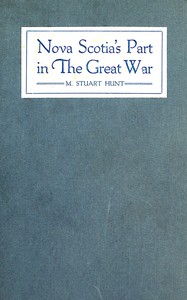
Nova Scotia's Part in the Great War — A Reader’s Guide
(0 User reviews)
714
Project Gutenberg
2020
Not confirmed
World War, 1914-1918 -- Canada; World War, 1914-1918 -- Nova Scotia
Readers of public-domain and historical texts
Project Gutenberg digital edition
en
Edition facts
Words
141,725
Reading time
617 min
Text sections
97
The source record for Nova Scotia's Part in the Great War — A Reader’s Guide measures this digital text at 141,725 words, 10 hr 17 min estimated reading time, and 97 detected text sections.
The text analysis averages about 17.1 words per sentence, while the detected sections provide another way to judge how the source is divided.
Project Gutenberg metadata also associates the work with “World War, 1914-1918 -- Canada,” connecting these edition facts with the source record’s subject description.
Source:
Project Gutenberg record #64101
An editorial note examining how the preface, unit rosters, and medical service sections of this 1920 provincial history guide a first reading, focusing on the editor's framing, the shift from narrative to lists, and the treatment of nursing sisters.
Read the complete public-domain text at its original source.
Read on Project GutenbergThe preface of Nova Scotia's Part in the Great War immediately establishes a dual purpose: to provide a “comprehensive history” of military units and patriotic organizations, and to assert the province’s “enviable record.” Editor M. S. Hunt, a captain in the Reserve of Officers, writes two years after the Armistice, framing the work as both a record and a tribute. The opening pages emphasize Nova Scotia’s unique contributions—its role as an Atlantic naval base, the shipment of troops and munitions from Halifax and Sydney, and the work of the Red Cross. This preface sets expectations for a narrative of collective achievement, but the excerpts that follow reveal a text that shifts between prose accounts and extensive rosters.
From Narrative to Lists
The preface promises a “review of each of the Military Units,” but the excerpts show that the book often delivers this through dense lists of personnel. For example, the medical section includes a string of names under “MILITARY MEDICAL SERVICE IN NOVA SCOTIA,” followed by a separate list of nursing sisters. These rosters are not merely appendices; they form the backbone of the book’s evidence. A first reader should note how the editor uses lists to convey scale and sacrifice, but also to create a sense of completeness. The transition from narrative to list is abrupt, and the reader must adjust to a mode where individual stories are compressed into name, rank, and service dates.
The Editor’s Voice in the Preface
Hunt’s preface is the most direct expression of editorial intent. He states that “no attempt has been made” before this to compile such a history, and he argues that Nova Scotia “surpassed the other Provinces” in certain respects. This claim is not supported with comparative data in the excerpts, so a reader should treat it as a rhetorical framing. The preface also includes a dedication “To The Immortal Memory of Our Fallen Comrades,” which signals the commemorative function of the book. The editor’s voice is confident and patriotic, but the later sections—such as the medical rosters—are more neutral and bureaucratic, creating a tension between celebration and documentation.
The Nursing Service as a Case Study
In the medical section, the editor pauses to highlight the “noble work of the nursing sisters,” stating that their service “has been stamped indelibly on hundreds of thousands of hearts.” This is one of the few moments of explicit praise in the excerpts, and it stands out against the otherwise terse entries for individual nurses, who are not listed with the same detail as medical officers. A first reader might observe that the book’s structure—a brief encomium followed by a list of names—mirrors the way the entire volume handles its subject: broad statements of valor give way to catalogs of individuals. The nursing section thus becomes a microcosm of the book’s method.
What the Excerpts Leave Unsaid
The excerpts do not include any battle narratives, personal letters, or accounts of combat. The focus is on organization and personnel. A reader approaching the full text should expect that much of the book consists of similar rosters and unit histories, with limited narrative flow. The preface’s mention of “the appreciation of the troops” and “grateful letters” suggests that the book may include such material later, but the excerpts do not confirm this. The reader should also be aware that the editor’s claim of comprehensiveness is qualified by entries like “No particulars available” for several officers, indicating gaps in the record.
For a first reading, pay attention to how the book balances its dual identity as a reference work and a memorial. The lists are not just data; they are the primary means by which the editor argues for Nova Scotia’s contribution. The preface provides the interpretive lens, but the rosters do the evidentiary work. Readers interested in the social history of the province will find the names and service details valuable, while those seeking narrative will need to piece together the story from the fragments provided.
That rainy afternoon, the rosters of nursing sisters in Nova Scotia’s Part in the Great War felt less like records than a quiet roll call of quiet courage. Eventually, those names drifted me toward another book’s list of the omitted—an eerie echo of grief’s selectivity. Later, The treatment of Armenians in the Ottoman Empire Documents presented to Viscount Grey of Fallodon — Story, Setting & Ideas waited on the shelf, patient as rain.
There are no reviews for this eBook.
There are no comments for this eBook.
Reader reflection
How will you remember this book?
Save your reaction, strongest insight, and memorable passage.
Your progress
0
/
10
2
How much did you enjoy the reading experience?
3
How likely are you to recommend this book?
4
Did the language feel accessible?
5
How well did it match your expectations?
6
Could you see yourself revisiting this book?
7
Did the book give you something worth debating?
8
Did any part of the book stay with you emotionally?
9
In one sentence, what did you learn?
10