1

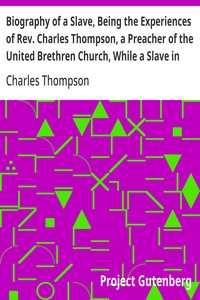
Biography of a Slave, Being the Experiences of Rev. Charles Thompson, a Preacher of the United Brethren Church, While a Slave in the South. Together with Startling — A Reader’s Guide
(0 User reviews)
1505
Project Gutenberg
2006
Not confirmed
Enslaved persons -- Mississippi -- Biography; Thompson, Charles, 1833-; Church of the United Brethren in Christ (1800-1889) -- Clergy -- Biography; African Americans -- Mississippi -- Biography; African American clergy -- Mississippi -- Biography; Fugitive slaves -- Mississippi -- Biography; Plantation life -- Mississippi -- History -- 19th century; Enslaved persons -- Mississippi -- Social life and customs; African Americans -- Mississippi -- Religion; Slavery -- Mississippi -- History; Enslaved persons' writings, American -- Mississippi
Readers of public-domain and historical texts
Project Gutenberg digital edition
en
Edition facts
Words
25,353
Reading time
111 min
Text sections
3
The source record for Biography of a Slave, Being the Experiences of Rev. Charles Thompson, a Preacher of the United Brethren Church, While a Slave in the South. Together with Startling — A Reader’s Guide measures this digital text at 25,353 words, 1 hr 51 min estimated reading time, and 3 detected text sections.
The text analysis averages about 23.8 words per sentence, while the detected sections provide another way to judge how the source is divided.
Project Gutenberg metadata also associates the work with “Enslaved persons -- Mississippi -- Biography,” connecting these edition facts with the source record’s subject description.
Source:
Project Gutenberg record #9941
Charles Thompson's 1875 narrative recounts his enslavement in Mississippi, his self-taught literacy, and his path to becoming a preacher in the United Brethren Church, using plain English and a deliberate rejection of dialect.
Read the complete public-domain text at its original source.
Read on Project GutenbergCharles Thompson opens his 1875 narrative with a preface that immediately establishes his dual purpose: to do good for his race and to present a truthful account. He explicitly states he is not a book-maker and makes no literary pretensions, grounding his authority in honesty rather than style. Thompson chooses the narrative form to suit his colored readers and deliberately uses simple, plain English, discarding the idiomatic and provincial language of southern slaves and ignorant whites, aiming to educate black readers in proper language. This authorial choice—a conscious rejection of dialect in favor of standard English—shapes the entire work, marking it as both a personal testimony and a pedagogical tool.
A Self-Conscious Authorial Voice
Thompson's preface reveals a writer acutely aware of his audience and his own limitations. He claims no literary attainments and admits his manuscript was rewritten by William H. Rhodes, an attorney. Yet Thompson retains control over the book's linguistic register, opting for plain English over dialect. This decision is not merely stylistic but ideological: he believes proper language will help educate black readers. The narrative thus carries a dual voice—Thompson's own experiences filtered through a polished, standard-English lens. This tension between authenticity and uplift is central to the work's texture.
Literacy as a Subversive Act
Thompson recounts learning to read and write from white schoolchildren, a detail that underscores the clandestine nature of enslaved literacy. He does not elaborate on the method, but the mere fact that he acquired these skills despite prohibitions is a quiet act of resistance. Later, he notes that his sermons, though earnest and honest, were originally delivered in the language of southern blacks and uneducated whites. Through hard study, he improved his pronunciation, gaining a reputation for correctness. Yet he admits he is not entirely free from dialectic pronunciation and finds that this very defect adds force to his sermons. This self-awareness about language as both a tool and a marker of identity is a recurring thread.
The Vocabulary of Enslavement and Providence
Thompson's diction reveals a worldview in which divine will and human bondage coexist. He describes being removed from one field of labor to another as God's doing, stating he was content to do the will of God whether expressed through slave-laws and James Wilson or otherwise. This phrasing collapses the distinction between divine and human authority, presenting enslavement as a sphere of providential action. He also uses economic metaphors: he has been a depositor in God's bank, from which he expects to draw largely at the final settlement. Such language blends the material realities of slavery with a spiritual economy, offering a distinctive lens on his experience.
Defining Southern Institutions Through Contrast
Thompson takes care to define the word grocery for his northern readers, explaining that in the South it means a place where whisky and other intoxicating beverages are sold, where planters congregate to drink, carouse, gamble, quarrel, and fight. This gloss is one of several moments where he explicitly bridges regional and cultural gaps. He similarly clarifies the nature of slave laws and the role of owners. These explanatory asides reveal Thompson's awareness of his audience's ignorance and his desire to educate them about the specificities of southern life. They also demonstrate his control over the narrative, as he shapes how readers interpret the events he describes.
Thompson's narrative is best approached as a deliberate construction, not a transparent record. His preface and textual choices—from the rejection of dialect to the providential framing of enslavement—invite readers to consider how an author shapes his own story for a specific purpose. Pay attention to moments where Thompson defines terms or explains customs; these are clues to his rhetorical strategy. The work rewards careful reading of its language, which is never artless despite its plainness.
Reading Charles Thompson’s steady, self-taught words, I remembered my grandfather’s ledger—spidery script hiding a mind that refused to be owned. That quiet defiance felt familiar, like the first time I held History of the Girondists, Volume I Personal Memoirs of the Patriots of the French Revolution — A Reader’s Guide and saw same hunger for a world beyond one’s given place. Both books whisper: a life is still a life, even when recorded in borrowed margins.
There are no reviews for this eBook.
There are no comments for this eBook.
Reader reflection
What did you think of this book?
Answer a few questions and save a private reflection on this device.
Your progress
0
/
10
2
Was reading this book enjoyable?
3
Would you recommend this book to another reader?
4
How easy was the book to follow?
5
How useful did the reading feel?
6
How strong was your personal connection to the text?
7
How clear did the writing feel?
8
How much did the book move you?
9
What did this book teach you most?
10