1

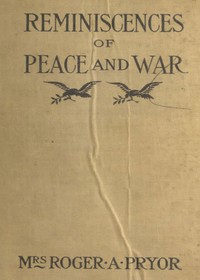
Reminiscences of Peace and War — Themes and Context
(0 User reviews)
374
Project Gutenberg
2018
Not confirmed
United States -- Politics and government -- 1849-1861; United States -- History -- Civil War, 1861-1865 -- Personal narratives, Confederate; Washington (D.C.) -- Social life and customs; Pryor, Roger A. (Roger Atkinson), 1828-1919
Readers of public-domain and historical texts
Project Gutenberg digital edition
en
Edition facts
Words
111,316
Reading time
484 min
Text sections
32
The catalog record for Reminiscences of Peace and War — Themes and Context provides practical reading context through 111,316 words, 8 hr 4 min estimated reading time, and 32 detected text sections.
The text analysis averages about 17.4 words per sentence, while the detected sections provide another way to judge how the source is divided.
Project Gutenberg metadata also associates the work with “United States -- Politics and government -- 1849-1861,” connecting these edition facts with the source record’s subject description.
Source:
Project Gutenberg record #58523
Sara Agnes Rice Pryor's memoir shifts from Washington society in the 1850s to the hardships of Civil War Virginia, using a woman's perspective to detail social customs, political figures, and the strain of wartime life, with a notable change in pace and tone.
Read the complete public-domain text at its original source.
Read on Project GutenbergSara Agnes Rice Pryor's memoir opens in Washington society during the 1850s, describing literary circles, presidential inaugurations, and diplomatic balls with a measured, observant tone. The early chapters move at a leisurely pace, cataloging figures like John P. Kennedy and Anna Cora Mowatt, and detailing the etiquette of court dress under President Pierce. This social panorama, however, gives way to a markedly different register as the narrative approaches the Civil War.
The shift is not abrupt but accumulates through details: the mention of her husband Roger A. Pryor's mission to Greece, the ball at the Hôtel de Ville, and the calm before the storm. The voice remains that of a woman recording what she saw, but the texture of the prose changes—from the measured descriptions of Washington parlors to the stark, immediate scenes of camp life on the Blackwater. The reader watches the author's world contract from the White House levees to a wooden waiting-room in a swamp.
From Drawing Rooms to Swamps
The most striking structural feature of this memoir is the contrast between its first half, set in Washington, and its second, set in wartime Virginia. In the early chapters, Pryor describes the Fillmore and Pierce administrations with the eye of a social chronicler: she notes the literary society of John P. Kennedy and G. P. R. James, the inauguration ceremonies, and the challenges of court dress. The pace is unhurried, the tone detached and observant. By the time she reaches the Blackwater camp, the prose has tightened. She writes of arriving at twilight, alone with her children, to find “a dead, bare level, as far as the eye could reach” and a “mighty concert” of frogs. The shift in setting is accompanied by a shift in voice: the social commentator becomes a participant in hardship.
This change is not merely thematic but rhythmic. The early paragraphs are longer, filled with names and anecdotes; the later ones are shorter, more sensory, and more focused on immediate physical details—the wooden building, the gray sky, the waterlogged ground. The reader can trace the author's own adjustment from a world of manners to one of survival.
The Husband as a Figure in the Text
Roger A. Pryor, the author's husband, appears throughout the memoir, but his role shifts from a political figure to a military commander under pressure. In the Washington chapters, he is a diplomat sent to Greece; later, he is a general ordered to hold the Blackwater line “to the last extremity” with inadequate forces. The excerpts show him receiving letters from superiors that combine strategic demands with dark humor: “annoy the villains all you can, and make them uncomfortable.” The author does not dwell on her own emotions about these orders, but the juxtaposition of official correspondence with her quiet arrival at camp creates a subtle tension.
Pryor's own preface, written by her husband, frames the book as a woman's perspective, “neither the dignity of history nor the authority of political instruction.” This framing colors how the reader interprets the later sections: the narrative does not attempt to explain military strategy but instead records the domestic and social consequences of war. The husband's voice in the preface and the letters contrasts with the wife's narrative voice, which remains personal and grounded in specific scenes.
The Weight of Small Details
Pryor's method is to build her account through concrete, often homely details rather than grand pronouncements. In the Washington chapters, she notes the dress of Queen Victoria at a ball, the advice of an “old resident” that leads to an unfortunate result, and the presence of Adelina Patti and Mrs. Glasgow. These details are not merely decorative; they establish a world of social codes and expectations. In the war sections, the details become more elemental: the box containing the camp outfit, the passenger car dependent on a transportation train, the postmaster preparing to lock his door. The author does not explain the significance of these moments; she lets them stand.
This reliance on observed particulars gives the memoir its texture. The reader is not told that the South was under strain but sees it in the scarcity of trains, the abandoned stations, and the lone woman traveling with her children. The narrative voice remains calm, even when describing the “ravenous, hunger-starved wolf” of hunger. The effect is cumulative: the small details, repeated and varied, create a sense of a world slowly coming apart.
Readers approaching this memoir should attend to the shifts in pace and voice as the narrative moves from peace to war. Pryor does not announce these changes; she enacts them through the rhythm of her prose and the selection of detail. The early chapters reward those interested in social history and political personalities; the later chapters offer a more intimate, sensory record of wartime life. The memoir is best read as a document of transition—both personal and national—recorded by a woman who watched her world change and chose to note what she saw.
Sometimes a book stays with you less for its battles than for what it quietly witnessed. Reading about Mrs. Pryor’s world unraveling made me think of another voice, one that later faced a different war’s horizon with that same exhaustion. There is a strange kinship in how both women recorded what they saw, without flourish. Women wanted: The story written in blood red letters on the horizon of the Great World War — Themes and Context holds that same ache, I think. I simply remembered it after closing the other.
There are no reviews for this eBook.
There are no comments for this eBook.
Reader reflection
Your personal reading reflection
Build a private reading journal entry for this title.
Your progress
0
/
10
2
How did the book work for you overall?
3
Would you encourage someone else to read it?
4
Did the language feel accessible?
5
Was the book moving at the right speed?
6
How clearly were the main ideas presented?
7
Did you gain anything practical from the text?
8
How strongly did the book affect you emotionally?
9
In one sentence, what did you learn?
10